Comparands
Established in 1902 in the French concession of Tianjin, and edited at various times in other major cities prior to 1949, Dagong bao, the “Impartial Daily” (大公報) was the largest newspaper based in the city, and the best newspaper at the time, according to Lin Yutang 林語堂 (1895-1976), a distinguished writer and translator who received his Master’s degree from Harvard in 1921. Through comparing several newspapers published in the 1930s, he concluded that the news in Dagong bao was much superior to that in Shenbao, especially in terms of the range of political and international news.[1]
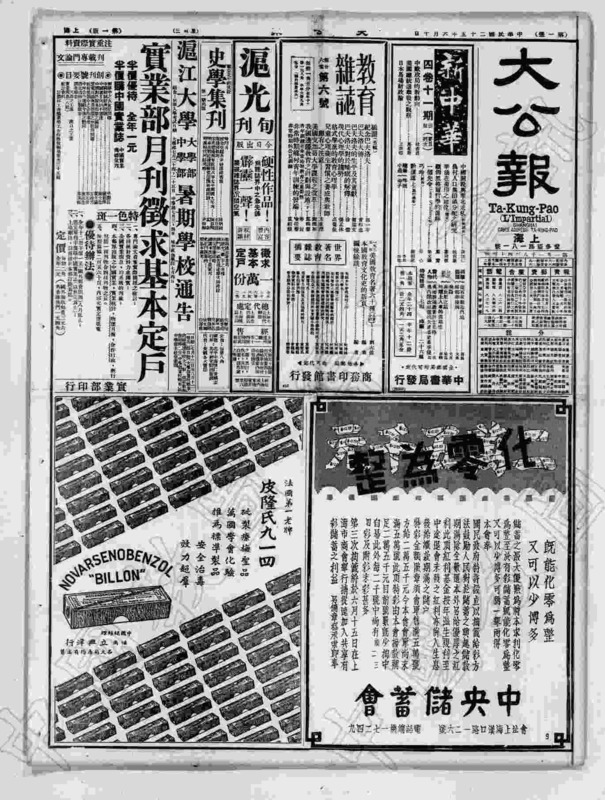
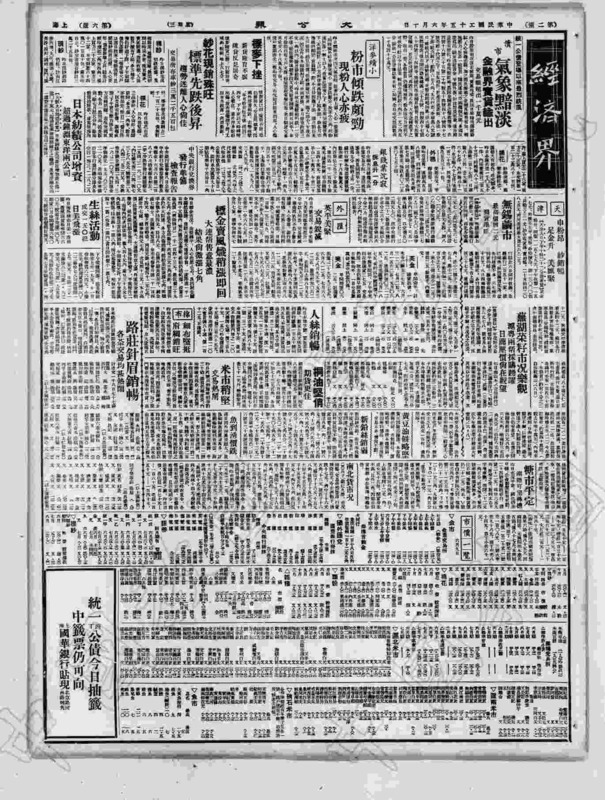
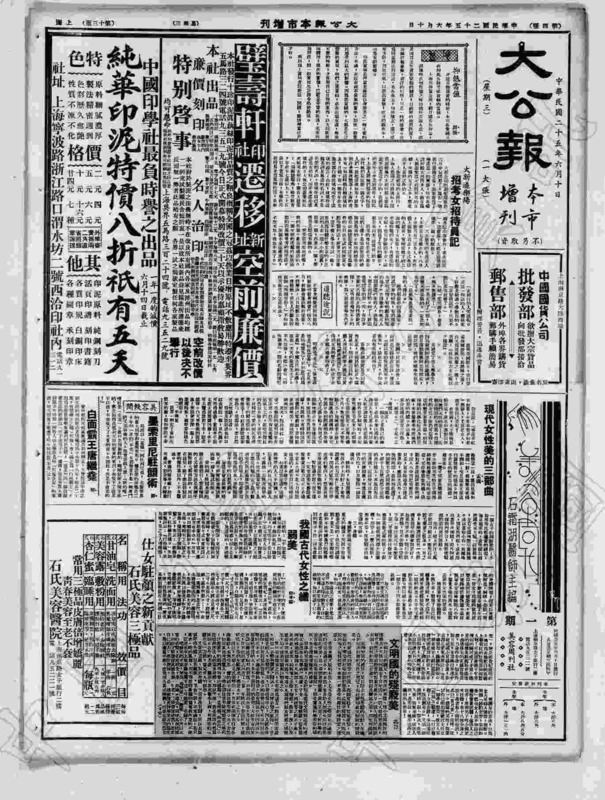
Under the threat of Japanese invasion of Tianjin in 1936, manager and editor-in-chief decided to establish a Shanghai branch as a backup. In order to compete with popular local newspaper in Shanghai, from April 1, 1936, early issues of the Shanghai version of Dagong bao delivered very high quality.Taking the issue published on June 10, 1936, as an example. Despite the first page devoted to mostly advertisements for schools and banks (see Figure1), most other pages feature only a few advertisements for medicine, stationery and theatre. When they appeared, they covered less than 1/4 of the space, usually in the form of texts, (see Figure 2). Acknowledged of the newspaper’s over-educated audience, only two months after the newspaper’s debut in Shanghai, Shi placed an advertisement for his beauty clinic on page 13 in the issue published on June 10, 1936. To align with the usual form of advertisements in Dagong bao, his advertisement consisted of texts only, whose style accorded with rest of the paper, conveying a sense of formality, (see Figure 3).
[1] For Lin’s criticism of Shenbao’s poor quality of news and layout, see Lin Yutang, A History of the Press and Public Opinion in China, 131-35.
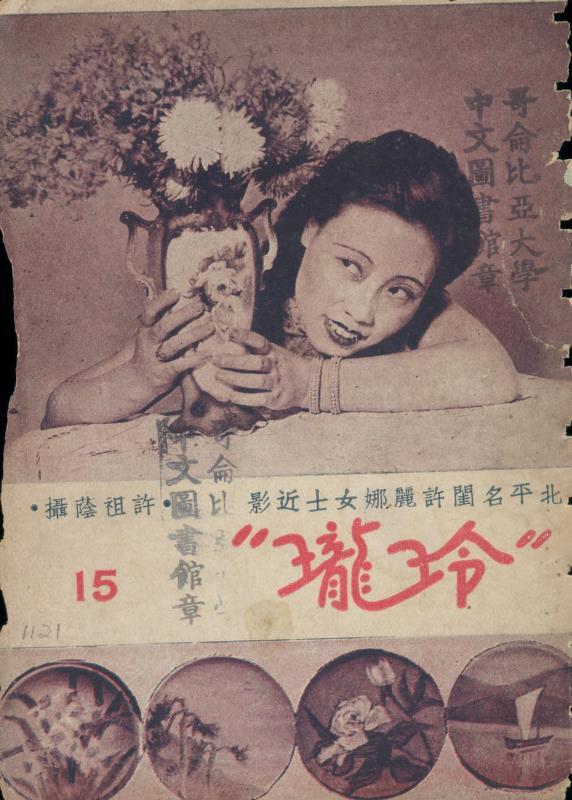
Ling Long women’s magazine玲瓏,[1] (see Figure 4) was a weekly women’s magazine published in Shanghai from 1931 to 1937. The pocket-sized magazine usually consisted of around 80 pages, standing 13 centimeters/5 inches high. The abundance of graphic images such as photographs, cartoons, and advertisements is an important resource for studying urban mass culture and women’s lives in 1930s Shanghai. Articles cover: advice on love and marriage; gossip on film stars; beauty and fashion tips; career advice; and interior decoration. Although the article on plastic surgery is mostly missing, the magazine involves many instructions to “beautified” and “made up” girls how to become an ideal modern woman.
[1] https://exhibitions.cul.columbia.edu/exhibits/show/linglong