Authorship
Leonard Digges was “an important member of the first generation of English mathematical authors to publish in the vernacular,” according to the Oxford Dictionary of National Biography. Born around 1515 to a Kentish gentry family, he likely studied at Oxford in the early 1530s before marrying and settling in his home county. In 1554, Digges was charged with treason in a revolt against Queen Mary, pardoned later that year, and accordingly fined in 1555. The Prognostication was likely printed for the first time in 1553, but one is tempted to ascribe the Tectonicon’s appearance to a need for cash to repay his legal debts. He died around 1559, and his legacy was carried on by his son Thomas.
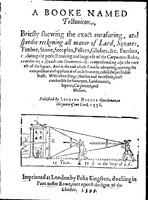
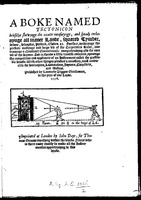
There is no ambiguity or equivocation when it comes to the authorship of the Tectonicon: from the very first edition of the text in 1556, Digges—“Gentleman”—is identified as the author of the work on the title page between the title and printer’s information. I assume that Digges was involved in the first edition, but he died before the subsequent editions were produced. When his complaints about errors in tables reach the sixth edition of the text, he seems to be referring more to tables in works by other authors and printers, not complaining about the execution of his own work (Houghton, STC 6851.2, sig. A2v).
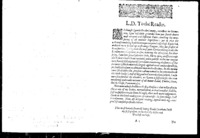
Not only does Digges clearly claim authorship of the text, he also tries to “author” his readers’ engagement with the text; he advises the craftsmen for whom the work was made to read this and his other texts three times for full comprehension and utility: “first confusedly to reade them through, then with more iudgement. Reade at the third reading, wittely to practice: So fewe things shall be unknown” (Houghton, sig. A2r). Those craftsmen, listed on the title page and in the opening preface, are explicitly Digges’s intended audience.
I believe it is safe to assume this is a commercial publication since there are no indications of subscription or patronage. Indeed, in its earliest incarnations, the text functions as an advertisement for further commercial enterprises, for the name of the printer on the title page in the first and second editions of 1556 and 1562, respectively, precedes the following information: “dwellyng within the blacke Friers: who is there ready exactly to make all the Instrumentes apperteynyng to this booke” (Bodleian, STC 6849.5). This addendum disappears when Thomas Marshe takes over the book in 1570 (British Library, STC 6850.5). Although a thin book, its many figures and inserted tables suggest a high price per page, so an extra commercial element—steering customers to a shop offering the products described in the book—is not surprising and might have convinced the printer to produce the book in the first place. Additionally, Digges mentions his previous book, the almanac Prognostication, yet it is not clear whether he is promoting the almanac to boost sales or genuinely believes it will be useful for the audience of the Tectonicon (Houghton, sig. A2v).