Comparands
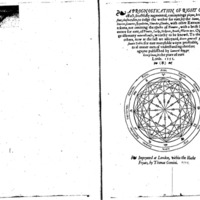
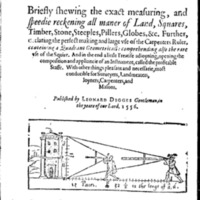
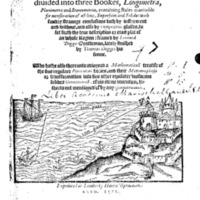
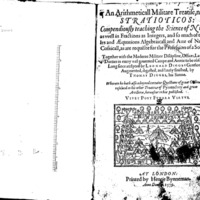
The Tectonicon has three natural comparands: Prognostication, Pantometria, and Stratioticos. All extant sixteenth- and seventeenth-century editions of these texts credit Leonard Digges as an author, and some also attribute a secondary authorship to his son, Thomas. They are all mathematical texts, though some are more practical or theoretical than the others.
Arranging the four texts into two generations—the first including Prognostication and Tectonicon and the second encompassing Pantometria and Stratioticos—highlights their bibliographical differences. The most immediate difference a reader gleans from each title page is authorship of the text within. The first generation was published while Leonard was still alive, presumably with his cooperation or, at least, consent; accordingly, he is credited as the sole author of both books. In contrast, the books of the second generation were only published for the first time in the 1570s, nearly a decade after Leonard’s death. Thomas is given explicit but ancillary treatment on their respective title pages: the Pantometria was “framed by Leonard Digges gentleman, lately finished by Thomas Digges his sonne” (STC 6858), and the Stratioticos was “long since atte[m]pted by Leonard Digges Gentleman, augmented, digested, and lately finished, by Thomas Digges, his sonne” (STC 6848). Whereas Leonard’s education is not certain in the historical record, these published books demonstrate Thomas’s learning: one finds Latin phrases scattered throughout the paratexts of the second generation (e.g. Thomas displaying his age and a motto, “Difficilia qvæ pvlchra,” in the colophon, sig. Ii1v) whereas Leonard’s Latin is restricted to quotations in a Prognostication preface (STC 435.35, sig. *4r–v).
The two generations also differ in terms of length and illustration. Although all four texts were originally released as portable quartos, the first generation is substantially shorter on average. The second-edition Prognostication runs for about 58 pages after the table of contents and two prefatory statements, and the sixth-edition Tectonicon contains 26 numbered folios in addition to a prefatory letter to the reader and two inserted tables (STC 6851.2). On the other hand, the declaration of multiple books within the title of the Pantometria signals its relative length, which stretches for about 250 pages. The leaner Stratioticos follows with about 200 pages. Perhaps as a result of the total length, or just as a consequence of each book’s content, the first generation features far more illustrations relative to the volume of text. For example, the last 13 pages of Prognostication are nothing but tables as calendars (sig. A1v–B23v). Then again, within the second generation, Pantometria displays several times more geometrical and figural images than does Stratioticos.
The frequency at which new editions of each book were produced confirms the generational distinction. 16 editions of the Tectonicon appeared in London between 1556 and 1692 from seven different printers, one of whom (Felix Kingston) was responsible for nine editions. Similarly, 13 separate editions of the Prognostication are extant today, not including the unattested first edition, and six printers working in London and Edinburgh between 1555 and 1619 produced them. Again, one printer (Thomas Marshe) held a monopoly on the text for two decades. The second generation did not see such unabashed success. Both texts were published twice in the sixteenth century—Pantometria in 1571 and 1591 and Stratioticos in 1579 and 1590—and only sparingly reissued or repackaged in the seventeenth century—Pantometria was reissued in 1603, and Robert Norton cited both texts on the title page of his 1624 Of the art of great artillery.
In sum, the four Digges texts constitute something of a mathematical printing dynasty in early modern England, and I hope to find more similarities and variations as I investigate further. For a full rendering of the printing histories of all four texts, please consult this database.