Reception History
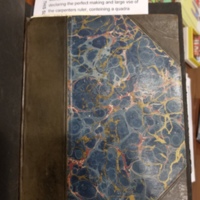
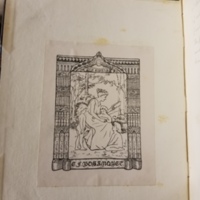
Since there are no marginal annotations or other obvious marks of reader engagement within the book I am studying, I will focus first on provenance and then on textual indications of reception. The sixth-edition copy of Leonard Digges’s Tectonicon in the Houghton Library (STC 6851.2) arrived at Harvard through the coincidental cooperation of two different scholars: Eustace F. Bosanquet and John Farrar.
Bosanquet authored a bibliography of English almanacs to 1600 (1917), two supplemental volumes to enlarge and correct that work (1928, 1937), and a second bibliography on seventeenth-century almanacs (1930), all of which were published in London by the Bibliographical Society. According to WorldCat, Bosanquet’s collection was sold by Sotheby’s auction house in 1917 and 1944, and I have requested the catalogues of those sales through ILL to confirm whether this copy of the Tectonicon made its way directly from Bosanquet (or perhaps his executors) to the Houghton Library or spent nearly three decades in private hands before reaching the university collection. Of course Bosanquet only catalogues editions of Digges’s Prognostication in his bibliography, but the Tectonicon does appear in the prose essay on different almanac classes.[1]
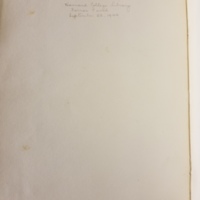
A manuscript inscription before the beginning of the text brings Farrar into the picture. From the inscription, we know that this book entered the Harvard collections on September 22, 1944, through the Farrar Fund. I believe the Farrar to which the fund’s name refers is John Farrar (1779–1853), an alumnus of the college (1803) who went on to serve as Greek tutor and later occupied the Hollis chair of mathematics and natural philosophy (1807–1836).[2] His mathematical appointment accords well with the content of Digges’s text. A second manuscript inscription suggests that this edition is not included in the Short Title Catalogue, but that is no longer the case. In fact, this exact copy is reproduced as an exemplar for the 1599 edition in the online database EEBO.
As mentioned in earlier discussions of Digges’s authorship and literary style, the audience of the Tectonicon is explicitly referenced from the opening pages of the text. In the first preface, Digges addresses his “Artificers,” including “Landmeater, Carpenter, mason” (sig. A2r), to which we can also add “Surueyers” and “Ioyners” from the title page. After six chapters and a table of computations, Digges interrupts with a second preface, in which he more specifically identifies his audience as craftsmen who are willing to cast aside their corrupted working methods. One finds no table of contents, index, or other finding aids throughout the book, so the reader is expected to read the book cover to cover and, thus, must be motivated to digest its contents.
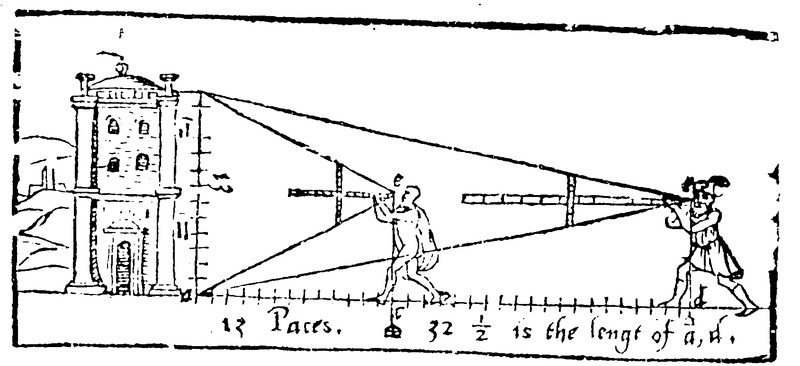
The printing history of the Tectonicon confirms its popularity. Sixteen editions are attested between 1556 and 1692 by six different printers (seven if you account for the jointly produced first edition). Between the 1599 and 1647 editions, Felix Kingston held an apparent monopoly on the text. All sixteen editions were printed in London. Most editions included the tables of computations and square roots except for the first, fourth, fifth, and eighth. The woodcut illustration at the top of this page appears on the title page of every edition before the last in 1692,[3] indicating a remarkably consistent transmission of information through the sixteenth and seventeenth centuries. Please refer to my growing database of editions and copies for a schematic rendering of this printing history.
[1] Eustace F. Bosanquet, English Printing Almanacks and Prognostications: A Bibliographical History to the Year 1600 (London: Chiswick Press for the Bibliographical Society, 1917), 63–4.
[2] John Fiske and James Grant Wilson, eds., Appletons’ Cyclopædia of American Biography (New York: D. Appleton & Co., 1898–1900), 2:419.
[3] I cannot confirm that it appears in the 1578 Marshe edition because there are no digital reproductions online, but the 1570 edition by the same printer does include it.