Authorship
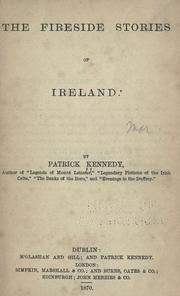
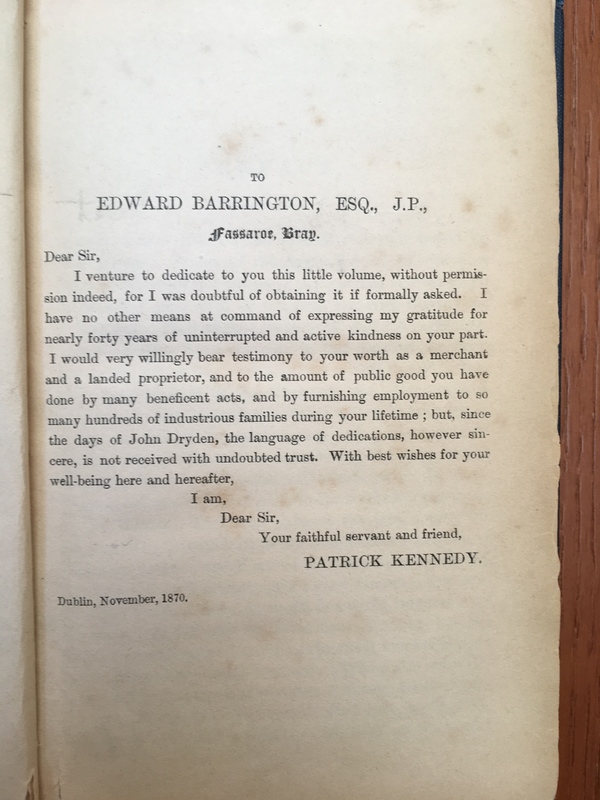
Beginning with the first few pages the names involved are only Patrick Kennedy, the publisher, printer, and a dedication from the Author to Edward Barrington Esq. of Bray. The dedication to Barrington provides little information regarding his relationship with the author. Barrington was apparently a merchant in Dublin and according to Kennedy’s dedication did much good for the public through independent acts and the employment of many local people. This in addition to the beginning which notes that Kennedy did not ask for permission from Barrington to mention him, because he believed he would say no, paints the picture of Barrington as an important member of the community and that perhaps Kennedy saw the benefits of his work while collecting the information for his book. It does not seem as though there was any patronage in the relationship. The letter of dedication is also dated to 1870 demonstrating its printing in inclusion with the original book.
Patrick Kennedy was a catholic Irishman born in county Wexford in 1801. He moved to Dublin in 1823 and upon finishing school opened up a library and bookshop. Kennedy was a prolific scholar and published many works during his time. He was well known for his descriptions of rural life in Ireland and was generally believed to be unsurpassed in quality of writing regarding it.[1] During his lifetime Kennedy published under two names, his own and the pseudonym Harry Whitney. It seems that the pseudonym was used primarily during his early period of writing, and does not seem to appear after 1855 on The Legends of Mount Leinster. This is perhaps due to Kennedy’s growing popularity in the literary realm, especially as a folklorist.
According to his preface Kennedy’s purpose was to write down the oral stories that he felt were beginning to vanish with the diminishing of oral storytelling. It had been his hope to include elements from other myth cycles within the oral tradition, he names the Ossianic tales (another name for the Fenian cycle), but thought his readers would not be interested in this topic in addition to the other tales. He therefor expressed a plan for another book in which these elements of his research would be highlighted.
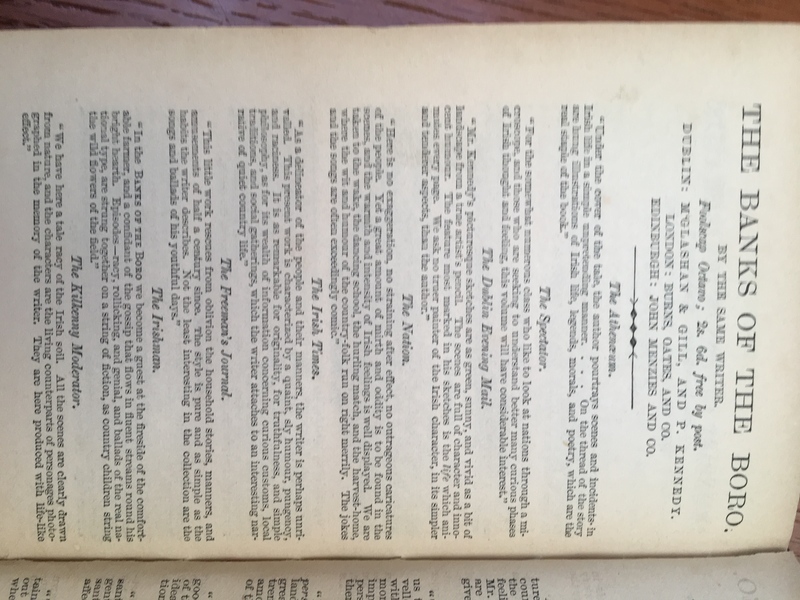
With all this in mind it is very clear that Patrick Kennedy, at the time this book was published, was a well-known figure in Irish literary circles. This is seen in the title page where other books by the author are listed under his name, but also in the last few pages of the book where each of these titles is given a page of blurbs of praise taken from Irish newspapers and literary publications. This seems to highlight the author, and also demonstrate the commercial element of the books, which appears significant in the advertisement-like pages at the back. If these pages drew solely from academic periodicals I think that it could be argued that they were testifying to the quality of the author and signifying further research in the field. However, the use of popular newspapers inclines me to believe that they were solely for commercial purposes, and indeed connect some books written under the name Harry Whitney with the now well-known Patrick Kennedy.
[1] “World Biographical Information System.”