Authorship
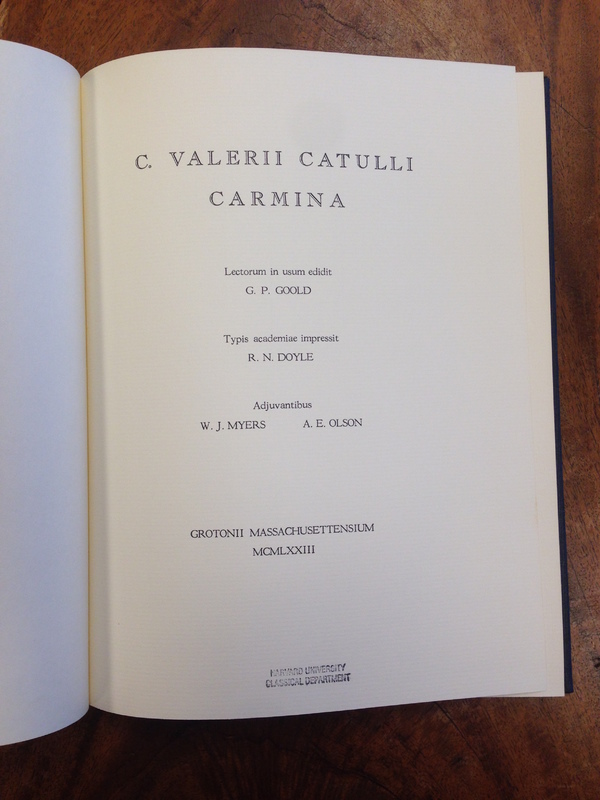
This is the title page of C. Valerii Catuli Carmina. The first line of Latin translates to "produced for the use of readers," and below it is the name of the editor. The second line of Latin translates to "printed with the types of the school," followed by the name of the student who printed the book. "Adjuvantibus" means "with assisting," and below it is the name of a Classics teacher at the school and the Press master. The location of printing is at the bottom of the title page, in Latin (Groton, Massachusetts), and the year is in Roman numerals (1973).
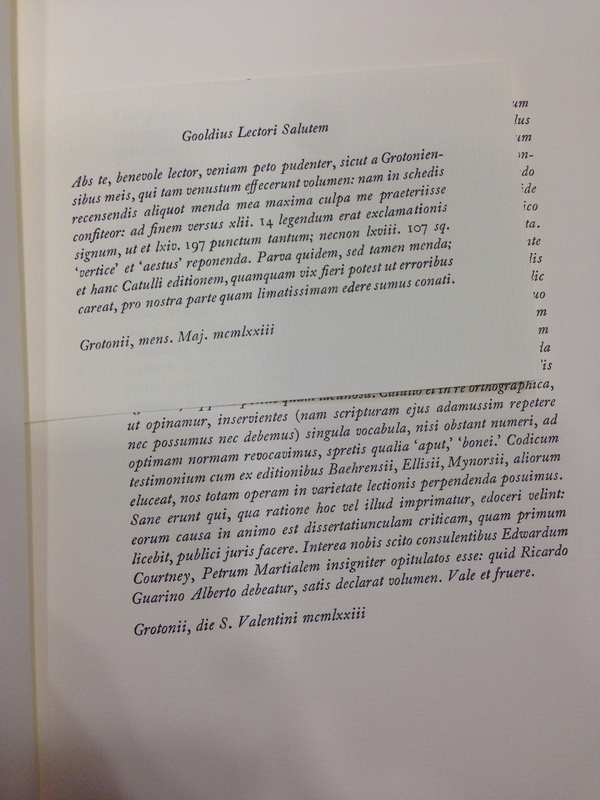
This is a loose errata list, in which Goold expresses his apologies and asks for pardon because he has made errors in the text. Below it is a greeting from Goold to the reader, which serves as an introduction to the text.
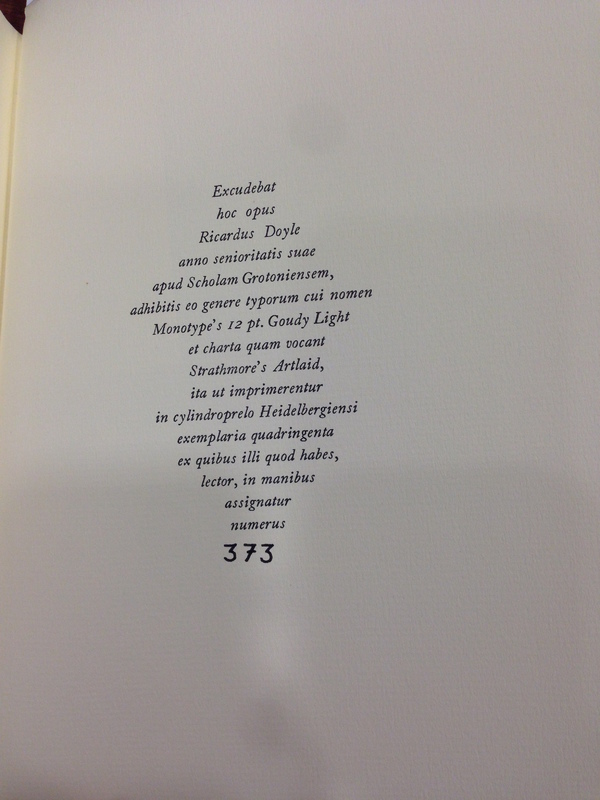
This is the colophon, and in it is written: This work was printed by Richard Doyle, in his senior year at Groton School, with that kind of type called Monotype's 12 pt Goudy Light, and on that paper called Swarthmore's Artlaid, and thus four hundred copies were printed in a Heidelberg press, from which the one you have in your hands, reader, is assigned the number ___. In the blank is what looks like a handwritten number: the copy in Smyth Library is number 24, whereas the copy in Houghton is number 373.
The title page of C. Valerii Catulli Carmina states that the book was edited by G. P. Goold, printed by R. N. Doyle, and that W. J. Myers and A. E. Olson assisted in the production of the book. The Carmina themselves were written by Gaius Valerius Catullus (c. 84 BCE. – 54 BCE), one of the poetae novi, a group of poets who went against the traditional norms of poetry, in the manner of the Greek neoteroi of the Hellenistic Period. The poems range from elegy to the sexually explicit to epic-style wedding hymns to sweet love poems.
George Patrick Goold (1922–2001) was a Classics professor at Harvard University, University College London, and Yale University. He was the editor of the Loeb Classical Library from 1974 until 1999. According to a review written by Otto Skutsch, mentor to Goold while he was in London, Goold's Carmina "differs from the Oxford text in more than 130 places," and it was considered to be one of the boldest editions of the Carmina at the time. Richard Doyle graduated from Groton School in 1973, the same year Carmina was printed as his final senior year project. Albert Olson was press teacher at Groton School during the mid- to late 20th century, and Warren Myers, former Classics teacher at Groton School, recommended Catullus to Doyle and contacted Goold for his edition of the text.
There were four hundred copies of the book printed, and it seems that Richard Doyle printed all of them himself. There is a large amount of white space on each page, focusing attention on the words. There was most likely no incentive to save paper (called Stratsmore's Artlaid), as it was printed for the purpose of a sixth-former's final project and not for wide commerical distribution. In his introduction to Carmina – entirely in Latin, as is the whole book – Goold explains that he wanted to publish Catullus's poems not "inelegantly and tastelessly" as in other versions of Carmina, in a format unencumbered by cramped notes.
It is likely that the Groton School funded the publication of the Carmina, as Groton School had a required printing press class until the Press went out of use and probably encouraged Doyle's project. The Press was used to print the Third Form Weekly, a school newspaper printed by the third-formers, and other Classics texts such as vocabulary lists. Goold also published his edition of Horace's Odes via the Groton School Press, in 1977. Skutsch writes that Myers approached Goold in January 1973, which means that Goold produced his edition and the book was printed "almost without a flaw" within the year. These flaws were corrected in a loose errata list inserted into each book. The errata list is missing from the copy in the Smyth library.
Only 400 copies of C. Valerii Catulli Carmina were printed, but because of Goold's renown and reputation, it was received attentively by a broader academic audience. It was considered to be quite a daring edition of Catullus's poems, and later editions did not follow most of his corrections to the text. Each copy of Carmina is customized (individually numbered in the colophon), and so perhaps these books were given as gifts, like collector's editions. Carmina can be seen to have benefited both Doyle, who originally conceived the book as his graduation project, and Goold, who was able to publish his edition of Carmina and to have control over how his edition was printed, a benefit of publishing through a private press. He returned to the Groton School Press to publish his edition of Horace's Odes four years later.
Sources:
Reyes, Andres T. “Preface.” Intermediate Latin, Oxbow Books, 2008.
Skutsch, O. “Classical Philology.” Classical Philology, vol. 69, no. 2, 1974, pp. 126 127. JSTOR, JSTOR, www.jstor.org/stable/268740