Material Bibliography
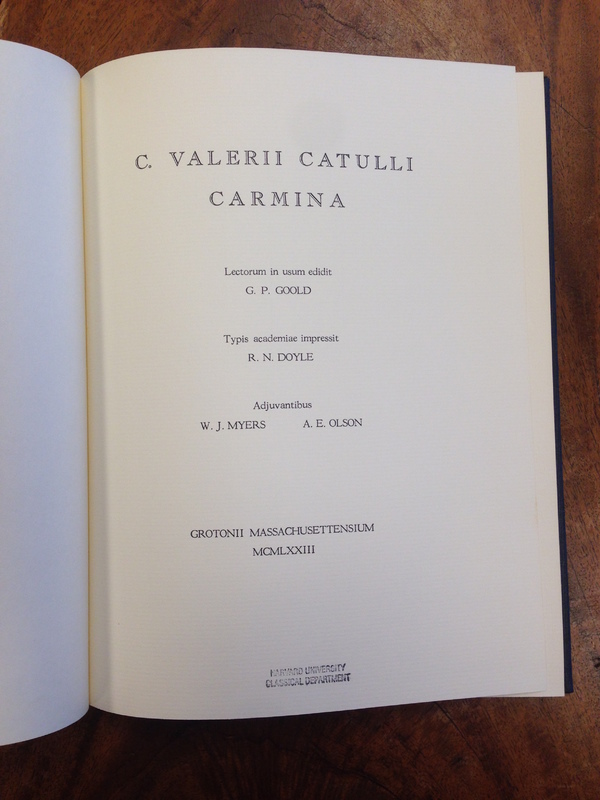
C. Valerii Catulli Carmina (The Poems of Gaius Valerius Catullus) was printed at the Groton School Press in Groton, Massachusetts, in 1973. It was printed by Richard N. Doyle as his final senior year project, at the encouragement of his teacher Warren J. Myers, who approached George P. Goold, the editor of the book. The arms of Groton school appear on the cover, and the entire book is in Latin.
The book is printed on 152 pages of paper, and it begins with a blank page, followed by the title page printed on the recto. The title page includes the title of the book, then “Lectorum in usum edidit” (brought into the use of readers) G. P. Goold; “Typis academiae impressit” (pressed with the types of the school) R. N. Doyle; “Adjuvantibus” (assisting) W. J. Myers and A. E. Olson. Below these is the place of publication: “Grotonii Massachusettensium” (Groton School), and then the year of publication, 1973, in Roman numerals.
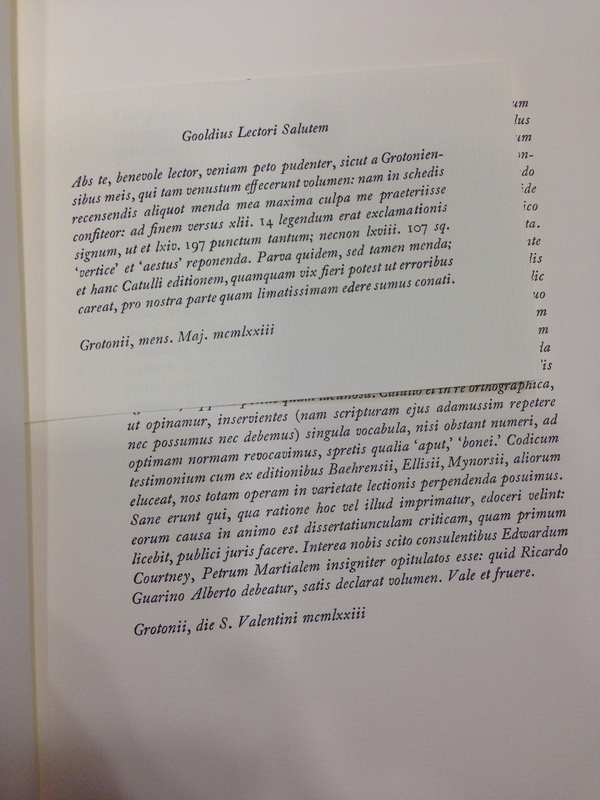
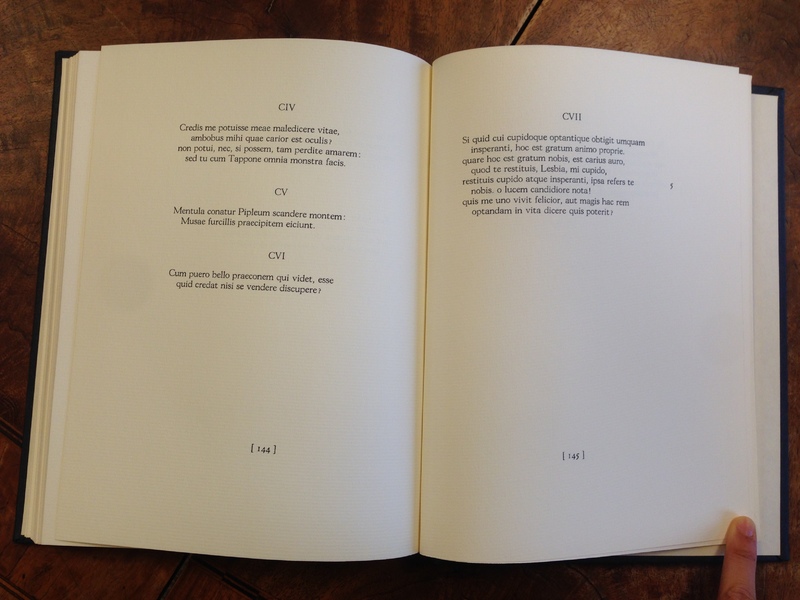
The next recto contains “Gooldius Lectori Salutem,” or a greeting to the reader, in which the story of how the book came into being is told, and there is a loose card also entitled “Gooldius Lectori Salutem” that functions as an errata list, asking for pardon from the reader. On the next recto is a poem, written by Benevenuto Campesani of Vicenza upon finding a lost manuscript of Catullus. On the verso is “Incipit Catulli Veronesis Liber” (the book of Catullus of Verona begins), and then the first of the poem is printed on the recto, starting on page 7, and subsequent pages with poems are paginated at the bottom of the page.
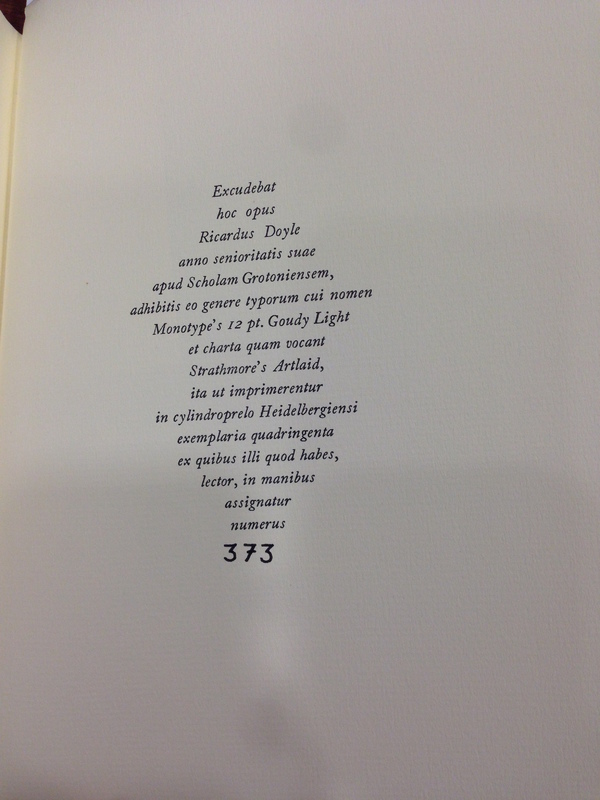
On the recto after the last poem is “Explicit Catulli Veronensis Liber,” signaling the end of the poems. On the final recto is the colophon, that states the names of the book’s font, paper, printing press, and the individual book’s number, out of the four hundred printed by Doyle. The book ends with a blank page.
Along with the high quality of the paper, the individualization of the colophon, and the large amounts of white space, the 400 copies of C. Valerii Catulli Carmina were most likely not for functional use and rather served as a special edition of Catullus. There were no signs of ownership in the two copies located at Harvard.
Sources:
Skutsch, O. “Classical Philology.” Classical Philology, vol. 69, no. 2, 1974, pp. 126–127. JSTOR, JSTOR, www.jstor.org/stable/268740.