Authorship
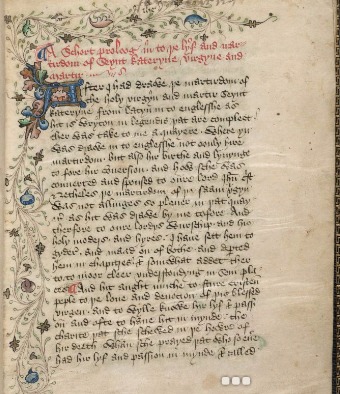
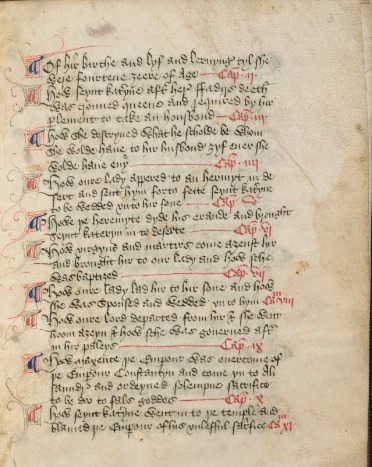
The main issue with Þhe lyf and martirdom of seynt kateryne virgyne and martir (also known as MS Richardson 44) is that it does not include any information about who wrote it.[1] There is nothing in the manuscript that could be considered a title page, although we do have a “schort proloog” heading the first section of the text that includes a little information about the author’s writing process. That there is no attributed author or title page is not terribly unusual for manuscripts of this period (Karen A. Winstead gives the date of MS Richardson 44 as c. 1420, although the Hollis listing places it between 1425-1450).[2] The prologue claims that the 4th century Alexandrian bishop Athanasius originally wrote this life of St. Katherine, as “he was one of the teachers of her youth,”[3] which is highly unlikely, as he was barely out of his teens at the time of her death.[4] Attributing the story to Athanasius definitely would have added credibility to this manuscript for the medieval reader, but it’s probably made up. Instead we ought to assume that this manuscript was written by a well-educated person, as the prologue claims that the text is a combination of another Middle English manuscript and a Latin version that was translated by the author. I am inclined to believe that it was written by a member of a religious order—male or female I am unable to say, as there is evidence that both wrote lives of St. Katherine prior to this manuscript’s production.[5]
This manuscript also has no dedication or reference to a patron, but it must have been financed by somebody, and probably that somebody was relatively wealthy, as the leaves of the manuscripts are gilt-edged and some of the illuminations have gold leaf. I believe that MS Richardson 44 was financed by a member of the nobility. The anonymous author takes time in chapter one to establish Katherine’s familial connections to the Roman emperors, and especially the ones rumored to have been born in Britain—why bother if not to create a link between the saint and the nobles in England in the 15th century? Additionally, as Winstead suggests, the manuscript was written right around the time of Henry V’s success in conquering France and his marriage to Catherine of Valois. Nationalist feeling was high.[6] For a rich nobleman, financing a life of the saint associated with the new queen would have been both the patriotic thing to do and politically expedient.
MS Richardson 44 was also probably intended to be read by members of the nobility, most likely women. For one thing, it’s written in Middle English vernacular—not Latin, not Greek. As Katherine Lewis explains in her book on the cult of St. Katherine, in the early 15th century, vernacular literacy was on the rise, especially among lay noblewomen, and many other saints’ lives were commonly written in the vernacular specifically for household (female) use.[7] Also, the very last chapter of the manuscript focuses on St. Katherine’s “five prerogatives” or especial virtues: wisdom, eloquence, stability, chastity/purity, and special privileges from God. All of these were certainly attributes noblewomen were expected to cultivate. The section on her chastity is especially revealing: even though Katherine’s wealth, youth, beauty, and freedom should have led to unchaste behavior, the author explains, she remained pure. If that’s not directly implying that Katherine’s chastity is something other young, beautiful, and wealthy women (read: noblewomen) should emulate, I don’t know what would.
[1] However, we do have information about the manuscript’s ownership history—the late 18th or early 19th century binding includes the binder’s stamp and various ex-libris markings from successive owners from the 18th century on. Those owners were all male, unlike the probable intended audience of MS Richardson 44. The binder was Christian Kalthoeber of London.
[2] Karen A. Winstead, Virgin Martyrs: Legends of Sainthood in Late Medieval England (Ithaca, N.Y.: Cornell University Press, 1997), pp. 115-116. Her dating is based on an unpublished dissertation by Auvo Kurvinen that I unfortunately could not get my hands on in time to evaluate for this particular assignment.
[3] MS Richardson 44, translation by Winstead in Chaste Passions: Medieval English Virgin Martyr Legends. (Ithaca: Cornell University Press, 2000), p. 118.
[4] Ibid, pp. 118 and 161. Athanasius was born in 293 CE, while the manuscript says that St. Katherine died in 309. Athanasius was indeed a highly prolific and influential writer and teacher, but not at age 16.
[5] Diane Auslander, “Clemence and Catherine: The Life of St. Catherine in its Norman and Anglo-Norman Context.” In Barking Abbey and Medieval Literary Culture: Authorship and Authority in a Female Community, edited by Jennifer N. Brown and Donna Alfano Bussell, 164-182. York: York Medieval Press, 2012.
[6] Winstead, Virgin Martyrs, pp. 156-158.
[7] Katherine J. Lewis, The Cult of St. Katherine of Alexandria in Late Medieval England (Woodbridge, Suffolk, UK; Rochester, NY: Boydell Press, 2000), pp. 176-179.