Reception and Printing History
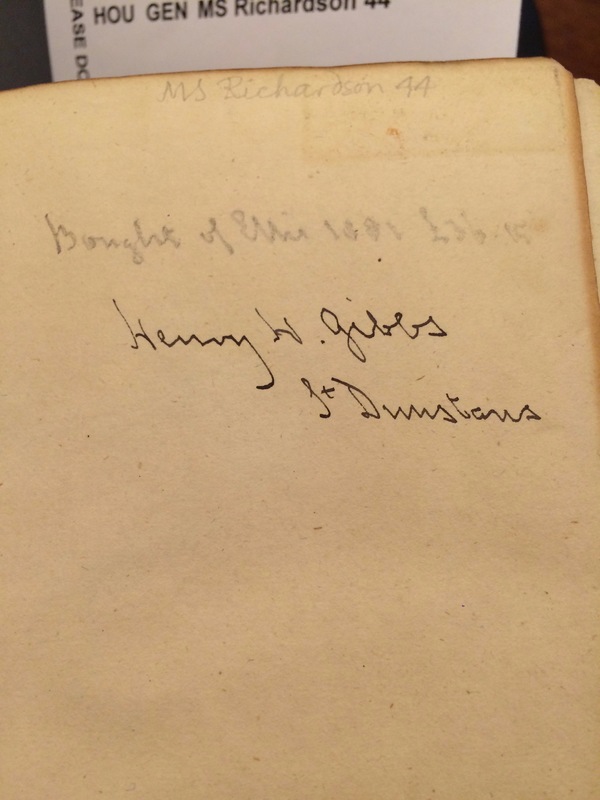
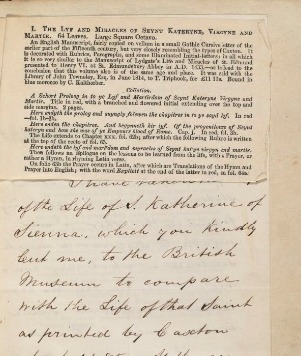
In MS Richardson 44, there are a multitude of ex-libris markings, clippings from auction catalogues, and even a letter from a 19th century evaluator of the manuscript. From all this we can determine a lot about who owned the manuscript from about 1800 to the present.[1] The first known owner was John Towneley (1731-1813), who was a book collector. He probably commissioned the binding by Kalthoeber (active 1780-1817). After his death, his son sold the collection, including MS Richardson 44, to pay for repairs to the family home. The MS was bought by John Triphook for £11 11s. He sold it shortly thereafter to a Rev. J. Duncalf, who then died; it was bought by Charles Hurt at his estate auction in 1836 for £2 10s. Before 1860 it passed into the hands of Charles Towneley, the original owner’s grandson. Either he or Hurt was the owner who wrote to William Blade asking for an evaluation of the manuscript—Blade’s 1858 letter, where he confuses the subject with another St. Katherine (of Sienna), is included in the binding. In 1860, Charles Towneley gave the book to John Denman, who appears to have never marked the book as his own. It was then bought at auction by Henry Hucks Gibbs, 1st Lord Aldenham, in 1881. His family bookplate is on the front endpaper and his own name is handwritten on an interior page of the manuscript. There he also records that he bought it for £36 15s. He later produced a printed transcription of the text. When Gibbs’ estate was sold in 1937, it was bought for £42 by William King Richardson, who donated it to the Houghton in 1951.
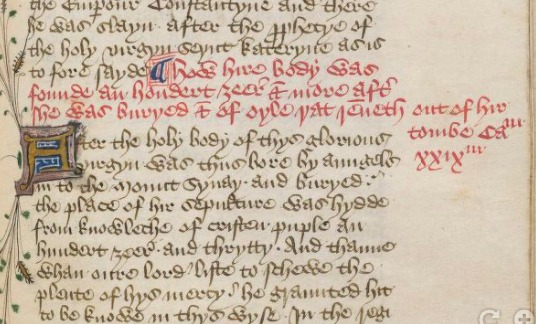
Although these various owners had no problem affixing their bookplates to the endpapers, pasting in catalogue clippings, and writing their names on the blank leaves, they left no other record of having ever used the manuscript. There is some evidence of use (some odd stains here and there, and one leaf has a small hole in it), but there are no marginal inscriptions or recorded reactions to the text. None of the owners prior to John Towneley wrote in the manuscript either. The most we can get are the tiny textual corrections that appear to have been done by the author himself—sometimes in the margin he’ll write “me” where in the text it says “mo.” He also seems to have done his own catchwords, which are placed at the bottom right of the page in little banners. And occasionally his text will stray into the margin, such as when he wrote the date of Katherine’s death, which is specially rubricated—perhaps indicating he didn’t switch off with his ink colors while writing and did all the rubrication at once, therefore showing how he might have underestimated the space he needed to complete the text. But other than these hints to the writing process, the manuscript itself gives no clues as to how anybody read it.
We do know, however, that St. Katherine’s story was very popular in late medieval England and that other manuscript versions were often read by aristocratic women and their households.[2] The popularity of her story is best seen in the many manuscript and printed versions of the legend that survive, although only a very few take their text directly from MS Richardson 44, making the compilation of a printing history complicated, as it is impossible to know which manuscript texts had the most influence on early printers.
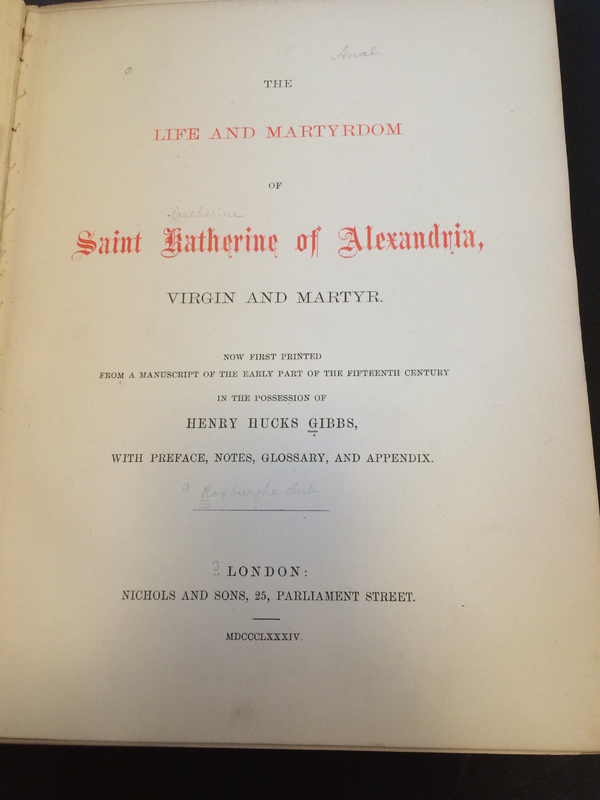
Karen Winstead believes that this manuscript is the oldest extant version of the prose legend in Middle English.[3] Other medieval writers, when writing Katherine’s story, tended to substitute a shorter version found in Jacobus De Voraigne’s Aurea Legenda (c. 1260), a collection of saints’ lives that was later translated into English and printed by William Caxton in 1483 as the Golden Legend.[4] Thus there were many other manuscripts telling similar stories of St. Katherine in England at the same time that influenced Caxton’s compilation. In any case, MS Richardson 44 does not seem to have been copied directly into any other surviving manuscripts apart from a shortened version given in the Southwell Minster MS 7. There is also a contemporary verse version of the story by John Capgrave.[5] MS Richardson 44 was first printed in 1884 in an edition done by Henry Hucks Gibbs[6], and has since been translated by Karen Winstead. These are the only exact printings of MS Richardson 44. There are other printed versions of the St. Katherine legend, such as the anonymous 1555 The life of the glorious and blessed virgin and martyr Saincte Katheryne,[7] and Dr. Eugen Einenkel’s 1884 translation of the Royal MS 17 A. xxvii,[8] that share DNA with MS Richardson 44, including phrases about Athanasius’ supposed authorship and the outline of the saint’s relationship to the emperor Constantine, but ultimately are not the same text.
[1] What follows is my best understanding of the ownership history based on my own examination of the manuscript and the Hollis Classic record.
[2] Katherine J. Lewis, The Cult of St. Katherine of Alexandria in Late Medieval England (Rochester, NY: The Boydell Press, 2000), pp. 180-184.
[3] Karen A. Winstead, Chaste Passions: Medieval English Virgin Martyr Legends (Ithaca, NY: Cornell University Press, 2000), pp. 116
[4] A version of the Golden Legend can be found at https://sourcebooks.fordham.edu/basis/goldenlegend/
[5] Karen A. Winstead, Virgin Martyrs: Legends of Sainthood in Late Medieval England (Ithaca, NY: Cornell University Press, 1997), pp. 156-157
[6] This seems to have been a lovely one time printing job, specifically for the members of the Roxburghe Club, of which Gibbs and his son were members. Although the title page only contains the elder Gibbs’ name, the dedication is presented by the son while the preface is signed by the father. I wonder if this was perhaps a collaborative family project. See Henry Hucks Gibbs, The Life and Martyrdom of Saint Katherine of Alexandria, Virgin and Martyr, (London: Nichols and Sons, 1884).
[7] Found on EEBO http://gateway.proquest.com.ezp-prod1.hul.harvard.edu/openurl?ctx_ver=Z39.88-2003&res_id=xri:eebo&rft_id=xri:eebo:citation:99844773
[8] Gibbs includes this translation in his 1884 book specifically so readers can compare the Latin and Middle English renderings of the legend. See Eugen Einenkel, The Life of Saint Katherine. From the Royal Ms. 17A. XXVII., &c., with Its Latin Original from the Cotton Ms. Caligula, A. VIII., &c. (London: Pub. for the Early English Text Society, by N. Trübner, 1884). https://books.google.com/books?id=BFEsAAAAYAAJ&pg=PP2#v=onepage&q&f=false