Comparands
These comparands are all variations on the same tale of St. Katherine’s martyrdom told in MS Richardson 44. It is unsurprising that there are so many available manuscript and print versions because St. Katherine had quite a following in late medieval Europe. These comparands were all influential on, contemporary with, or influenced by MS Richardson 44. I shall treat each one below.
The Life of St. Catherine—Clemence of Barking (not pictured)
Clemence of Barking, an Anglo-Norman nun of the late 12th century, wrote the only life of St. Katherine known to have been written by a woman. Since Katherine’s tale was frequently associated with women (in Clemence’s version, they are encouraged to read it and follow Katherine’s example), the fact of a woman’s authorship adds a layer to the way we can understand women’s interactions with the text. Written in French and missing a key part of the accepted legend (Katherine’s mystical sacred marriage to Jesus), this version was probably not directly influential for MS Richardson 44, whose author claims to have worked from Latin and Middle English versions. However, this version’s existence provides further opportunities for understanding the cult around St. Katherine in England that developed throughout the Middle Ages.[1]
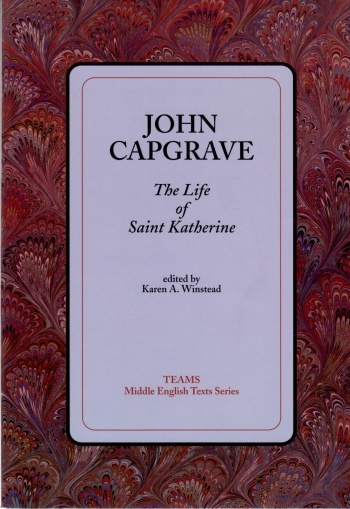
The Life of St. Katherine—John Capgrave
The other main Middle English 15th century version of St. Katherine’s life is the verse narrative penned by John Capgrave in about 1445. It is much longer than other hagiographical treatments, with 8000 verses, and is notable for its extensive attention to Katherine’s sacred marriage—possibly addressing concerns of female readers who worried about their own absent husbands (England was busy with wars in France and the internal Wars of the Roses at this time). It also develops the story's debate about a woman’s fitness to rule, much more so than MS Richardson 44 does.[2] In many ways, Capgrave’s version is an elaboration of MS Richardson 44.
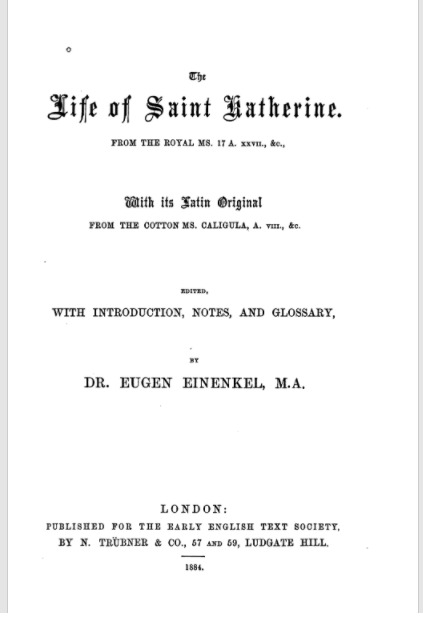
The Life of Saint Katherine of Alexandria from the Royal MS 17A XXVII—Eugen Einenkel
In 1884, Dr. Eugen Einekel made a translation of the Royal MS 17A XXVII, which is believed to have been written at the end of the 15th century, making it roughly 70 years younger than—and also possibly influenced by—MS Richardson 44. Unlike our manuscript, this one is in Latin and is also primarily written in verse. Yet like ours it takes time to establish St. Katherine’s connection, via the famous Roman emperor Constantine, to the British Isles. Perhaps there was some feeling in the air that Katherine needed to be made relevant to British readers through this genealogical connection. Henry Hucks Gibbs clearly thought that Einenkel’s work was relevant and useful to any study of our manuscript, and he included it as an appendix to his printed version of MS Richardson 44.
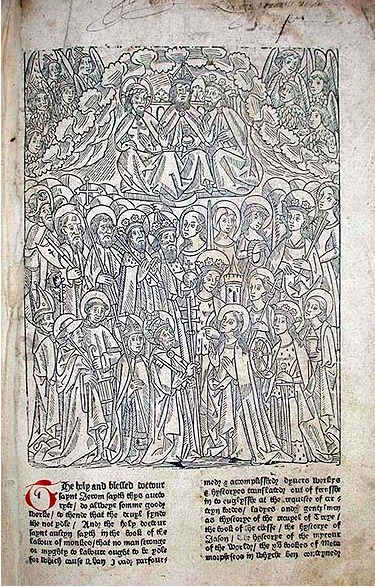
The Gilte Legende (The Golden Legend)—William Caxton
Although MS Richardson 44 didn’t make it into print until the 19th century, that doesn’t mean the legend was completely abandoned. One of the earliest printed versions of the St. Katherine legend was in William Caxton’s 1483 Gilte Legende, a huge compendium of saints’ tales that was mostly a translation from Jacobus de Voraigne’s 13th century Latin. However, Caxton was also influenced in his compilation by Middle English and French legends.[3] Some of the characteristics of MS Richardson 44 come through in the Gilte Legende, such as the attribution of the story to Athanasius, the connection to Britain through Constantine, and her sacred marriage to Jesus. Although it’s impossible to say whether Caxton had access to our manuscript, these were all accepted features of the saint’s tale by his printing, so he was obliged to include them.
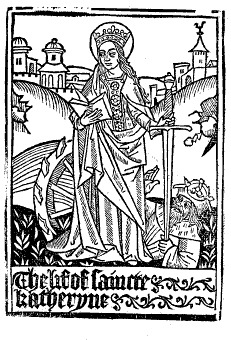
The Lyf of Saincte Katheryne
Another printed version of the tale was included in a 1505 printing by R. Pynson, alongside some woodblock illustrations. Although EEBO only has fragments of the original work, we can see that Katherine’s iconography was already developed—she is shown with the wheel that was part of her torture. Since MS Richardson does not have any illuminations of the saint herself, this is useful to confirm that all the details of her martyrdom remained known and used even without pictorial representation—more evidence of her cult in late medieval England.
[1] Diane Auslander, “Clemence and Catherine: The Life of St. Catherine in its Norman and Anglo-Norman Context,” In Barking Abbey and Medieval Literary Culture: Authorship and Authority in a Female Community, eds. Jennifer N. Brown and Donna Alfano Bussell, (York: York Medieval Press), pp. 164-182.
[2] Karen Winstead (ed.), “Introduction,” John Capgrave’s The Life of Saint Katherine, (Kalamazoo, Michigan: Medieval Institute Publications, 1999), accessed 5 November 2017, http://d.lib.rochester.edu/teams/publication/winstead-capgrave-the-life-of-saint-katherine
[3] Julie Gardham, “Book of the Month: William Caxton: The Golden Legend,” Glasgow University Library Special Collections Department, January 2007, accessed 5 November 2017, http://special.lib.gla.ac.uk/exhibns/month/jan2007.html