Material Bibliography
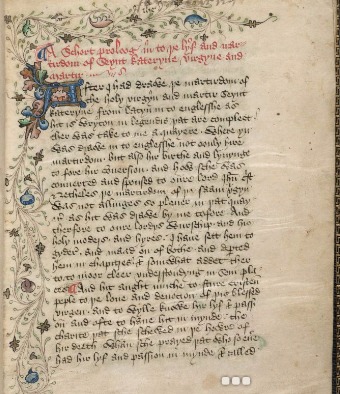
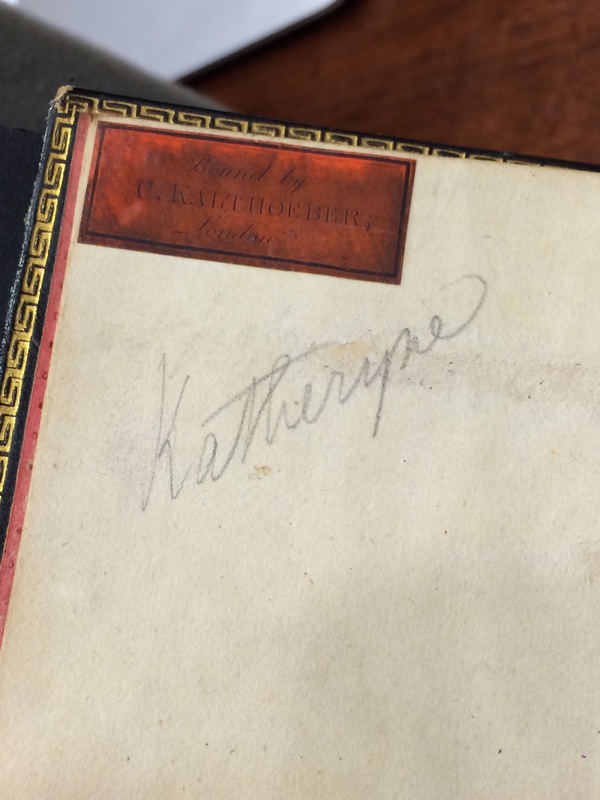
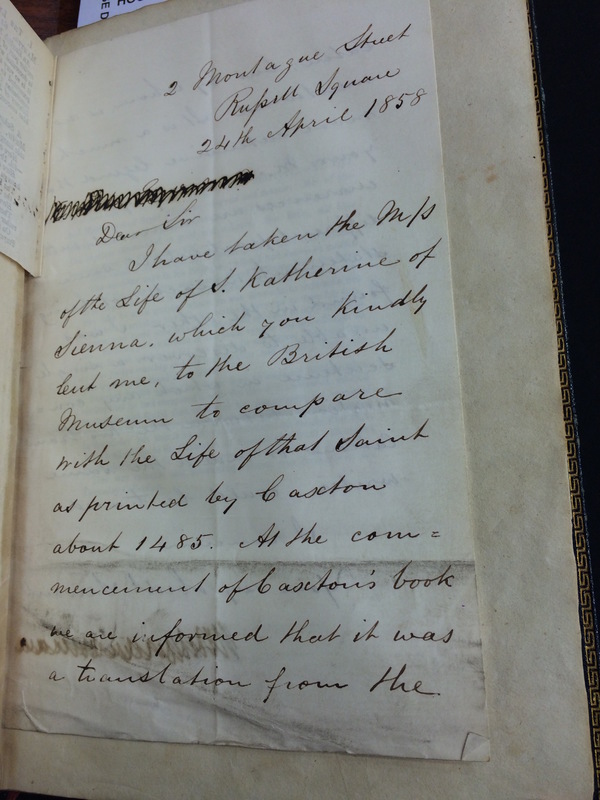
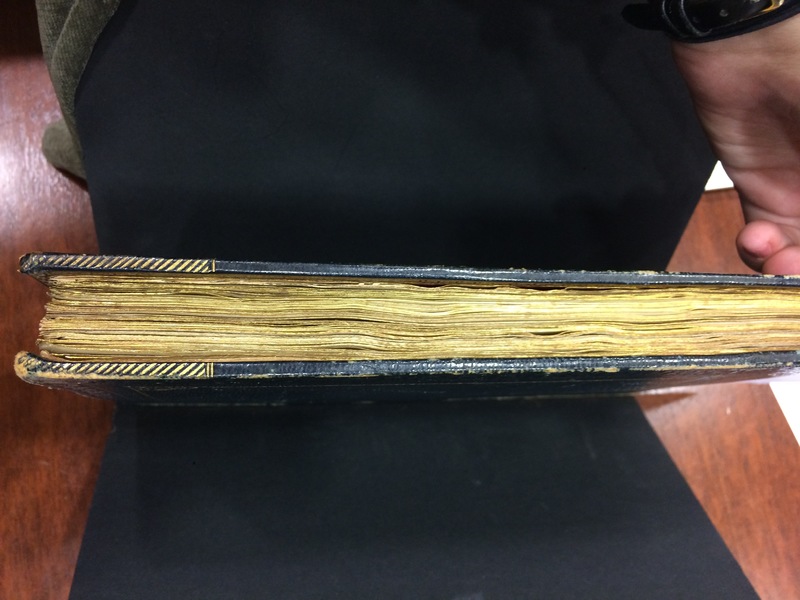
"The lyf and martidom of seynt katherine virgine and martir," author unknown, is a manuscript of 64 leaves created between 1425 and 1450 in England. It is written primarily in Middle English with some Latin on vellum, with many illuminations (mostly drawings of vines) and initial decoration. Each page of the manuscript is written in 1 column with 27 lines. The edges of the manuscript are gilded. There is substantial rubrication. There is no original foliation/pagination, though someone paginated it later. It was bound in blue morroco in the late 18th or early 19th century by Christian Samuel Kalthoeber. Included in the volume's flyleaves are multiple bookplates revealing the ownership history, several clippings from bookseller's publications describing the manuscript, and an 1858 letter from William Blades also describing the work. On the rear flyleaf, there is an 1836 note from Charles Hurt describing the auction where he bought the book.
St. Katherine of Alexandria, who lived in the 3rd century, was a very popular saint in medieval Europe, especially for women, as her virgin status and martyrdom provided an example of good Catholic womanhood. Although this particular manuscript has no ownership markings from before the 17th century, so it's impossible to be sure, it is possible the volume was created for a noblewoman's entertaiment or for educating young girls. Oddly, although St. Katherine's symbol was a wheel, there is no accompanying illustration in the manuscript, which may have led William Blade, in his letter, to confuse the subject of this text with St. Catherine of Sienna who lived many centuries after St. Katherine of Alexandria and wasn't even canonized until 1461, after this manuscript had been written.