Close Reading
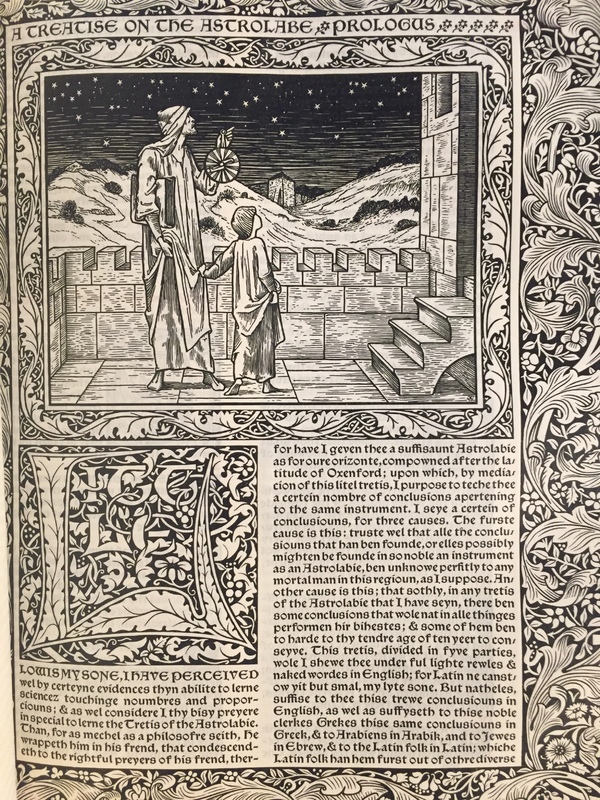
Middle English Text:
Little Lowis my sone, I have perceived wel by certeyne evidences thyn abilite to lerne siencez touching noumbres and proporciouns; & as wel considere I thy bisy preyere in special to lerne the Tretis of the Astrolabie. Than, for as mechel as a philosofre seith, he wrappeth him in his frend, that condescendeth to the rightful preyers of his frend, therefor have I geven thee a suffisaunt Astrolabie as for oure orizonte, compowned after the latitude of Oxenford; upon which, by mediacion of this litel tretis, I pupose to teche thee a certain nombre of conclusions apertening to the same instrument. I seye a certain of conclusiouns, for three causes. The furste, cause is this: truste wel that alle the conclusiouns that han ben founde, ells possibly mighten be founde in so noble an instrument as an Astrolabeie, ben unkowe perfitly to any mortal man in this regioun, as I suppose. Another cause is this; that sothly, in any tretis of the Astrolabie that I have syn, there bn some conclusions that wole nat in allle thinges performen hir behestes; & some of hem ben to harde to thy tender age of ten yeer to conseyve.
Modern English Translation (by James E. Morrison):
Little Lewis, my son, I see some evidence that you have the ability to learn science, number and proportions, and I recognize your special desire to learn about the astrolabe. So, as the philosopher said, “he serves his friend who grants his friend’s wishes”, [therefore I have given you a sufficient astrolabe suitable for our horizon and adjusted for Oxford]. I propose to teach you some facts about the instrument with this treatise. There are several reasons for this treatise. First, no one in this region has complete knowledge of the noble astrolabe. Another reason is that there are errors in the astrolabe treatises that I have seen and some of them present material too difficult for a ten year old to understand.
Commentary:
The Kelmscott Chaucer is an anthology of all firmly attributed works of Geoffrey Chaucer, and A Treatise on the Astrolabe is one of the Middle English poet’s lesser known works. In the prologue I have excepted here, Chaucer explicitly names his intended audience as his ten-year-old son Lewis. Lewis Chaucer was apparently a curious and intelligent youth who is father felt fully capable of learning how to use the astrolabe with a sufficient manual, which Chaucer aims to provide here. Since the treatise is being written for a child, the language Chaucer uses is remarkably clear and concise in his prose, avoiding difficult jargon and high-flown verse. In the last sentence of this selection, Chaucer also provides a commentary on other astrological writings of the time, saying that they are either too difficult for a youth to understand or that they reach incorrect conclusions. Additionally, Chaucer apparently locates himself as writing in Oxford (or, at the very least, his son’s residence). Like sundials, astrolabes are instruments which must be adjusted for a particular location in order for them to be accurate in their calculations. Later in the work, Chaucer provides a detailed description of the astrolabe he is using to write this manual, suggesting that the device was before him as he wrote and that he was writing in Oxford rather than London. Curiously, Oxford was a town of learning at the time Chaucer was writing in 1391, yet he notes that there is no one sufficiently educated in the region to teach young Lewis how to use the astrolabe. Perhaps the mere fact that this manual survived through several manuscript copies until the advent of printing fifty years later suggests that Chaucer’s intended audience was not just his son Lewis but the students at the University of Oxford as well. Indeed, Houghton Library’s manuscript of the Treatise (MS Eng 920) is tentatively dated to 1400, just nine years after its composition. If the intended audience was indeed larger than Lewis Chaucer, then one must reexamine and question Chaucer’s style of prose.
The case may be that Chaucer wanted to write an English manual for the use of the astrolabe for the education of scholars in the region but felt the need to provide an explanation for his simple style, especially if the reader were already familiar with Chaucer’s mature poetry. It also may be the case that his larger audience, like little Lewis, would have had a difficult time understanding the other works on the instrument, which may be in Latin, Greek, or Arabic (as identified elsewhere in the text), and Chaucer felt there was an opportunity to provide them with a clearer treatise than was available at the time and included correct calculations.