Reception History
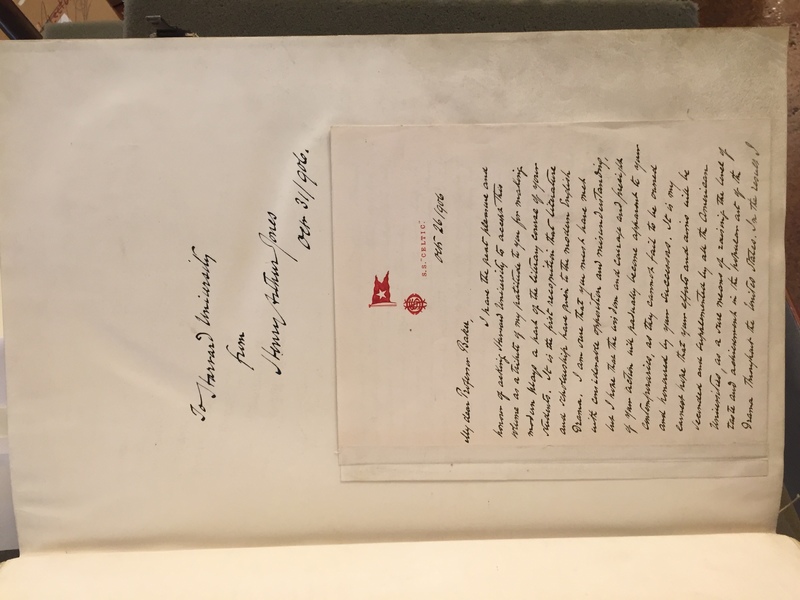
Being a new work unto itself and having a life of its own outside all Chaucer imprints and manuscripts hitherto or since, the Kelmscott Chaucer’s reception is to be examined alone. William and Sylvia Peterson do a remarkable job documenting the life of not only Houghton’s two Chaucers but of all known surviving copies in their Census. Houghton’s vellum copy has had largely a public life, living in Harvard’s collection since October 31, 1906. During its twelve years of freedom, it had only one owner, Henry Arthur Jones (1851-1929). Jones was a personal friend of William Morris and considered this book to be “the living handiwork of the greatest man whom [he had] ever known” in his letter accompanying the gift of this book to Harvard, which is taped to the front free end paper of the book. In donating the book to Harvard, Jones hoped that “the spirit in which William Morris printed this volume may guide the nascent art of America” (ffep). Since it has been in Harvard’s collection, this work has been displayed and exhibited to that end, participating in four exhibitions: two at Houghton Library; one at the Museum of Fine Arts in Boston; and at the Grolier Club in New York. While deposited at a library, the volume is often treated as a work of art to be admired rather than a text to be consulted, and this largely reflects the lives of the other known copies of the Kelmscott Chaucer.
Of the documented vellum copies, eleven reside in institutional collections and four in private hands. The reader will note that in the “Material Bibliography” section of this exhibit, it is stated that thirteen copies of the Kelmscott Chaucer were printed on vellum, which conflicts with the fifteen copies listed in the Peterson Census. As it turns out, two previously unattested vellum copies were assembled from “extra vellum sheets (‘overs’) of the Chaucer, created as insurance against spoilage” (Peterson 3). As each vellum sheet was run off the press, two or three extra sheets were also printed. From the two additional sheets come two complete volumes, and from the occasional third sheet that was run off come “proof” sheets that reside in various collections (Houghton has two such sheets in its collection, Typ 805K.96.275a).
As was traditional for special editions of books published in the latter half of the 19th century, a few copies were printed more lavishly for well-heeled collectors, with the copies being printed on large paper, bound more lavishly, or printed on vellum (Peterson 3). Although even the paper copies of the Kelmscott Chaucer were already to be costly volumes, Morris decided to create uber-luxury copies on vellum to satisfy the richest echelon of collectors. Since there have only been a few bibliophiles and institutions who could afford to own a vellum Chaucer, they have been less mobile, while the paper copies “have been associated with more individuals and, it might be argued, have developed more interesting personalities” (Peterson 23).
Of the 425 paper copies originally published, 281 unique paper copies of the Kelmscott Chaucer are accounted for in the Peterson Census. The 249 copies unaccounted for in the census are not necessarily lost or destroyed. Rather, they are impossible to identify them individually from bookseller’s catalogue records because of a lack of distinct descriptions. For example, a bookseller might have sold a paper copy of the Chaucer in 1998 bound its original blue holland boards, but have listed no other distinctive information about the book, such as ex libris plates or insriptions. Thus when another copy is sold at auction in 2003 with blue holland boards and no further special description besides condition, it is impossible to know if the 2003 copy at auction is a previously unrecorded copy or the 1998 copy being resold. While some copies were surely lost in the destruction of WWII and other disasters, the survival rate for Chaucer is quite high, which is likely due to its princely price and large size.
While many of the copies of the Kelmscott Chaucer have likely never been read as books, and thus probably few bear signs of readership, such as marginalia, they certainly exhibit the signs of collecting through their luxurious bindings. 144 documented copies retain their original quarter-linen blue holland bindings as issued from the press, 56 were bound by the Doves Bindery (like Houghton’s copy), and the rest have various other bindings (Peterson xiv). Some volumes were issued from the press in quarter pigskin over oak boards by Doves, ditto by J. & J. Leighton, and full pigskin by J. & J. Leighton (Peterson 203). The rebinding’s of many volumes is both a reflection on the fragility of the original quarter linen bindings and the invasive affections of their various owners. Some have been rebound in textile designed by William Morris while others have bindings made of solid sterling silver.