Material Bibliography

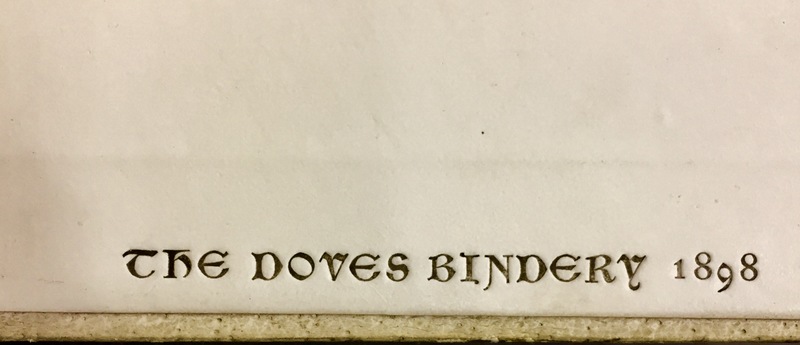
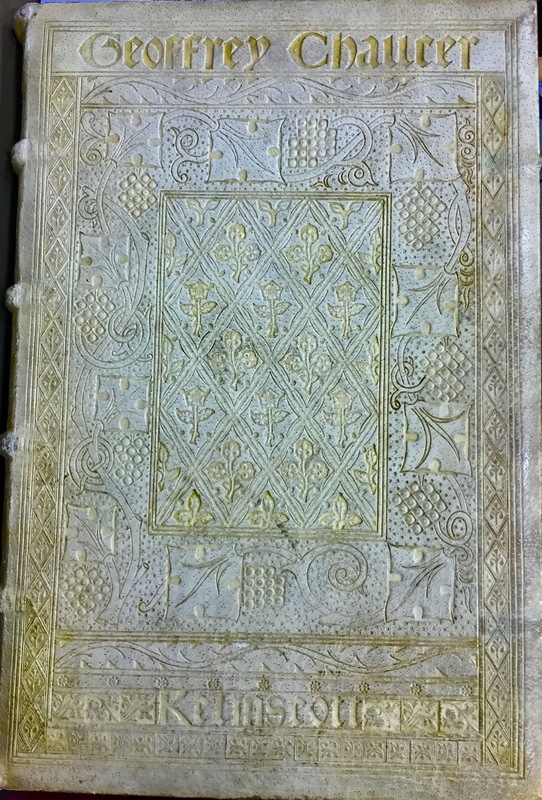
The typographical magnum opus of William Morris and a landmark of Western printing, The Works of Geoffrey Chaucer (commonly and hereafter referred to as the Kelmscott Chaucer) is remarkable due to its opulence, craftsmanship, typography, and rarity. Printed near the end of William Morris’ life, the Kelmscott Chaucer represents the culmination of Morris’ artistic talent, industry, and collaboration with other craftsmen operating in late 19th century England during the Private Press Movement. With 87 woodcut illustrations by the eminent Pre-Raphaelite Edward Burne-Jones, the Kelmscott Chaucer infuses a 14th century collection of texts with a freshness and subtlety of illustrations while simultaneously employing 15th century methods and aesthetic sensibilities. In addition to collaborating with Edward Burne-Jones, William Morris enlisted the help of Thomas Cobden-Sanderson of The Doves Press to design and execute 38 bindings of the Kelmscott Chaucer in fully tooled pigskin reminiscent of 15th century German bindings attributed to Ulrich Schreier (Peterson 244). Another incunabula-sourced feature of the Kelmscott Chaucer is the practice of printing several copies on vellum. With 425 copies of the edition being executed on large, Batchelor paper and 13 lavish copies printed on vellum, Morris follows in the path trod by the first printer, Johannes Gutenberg, in printing both on paper and vellum. Intriguingly, Morris chose to only print 13 copies on vellum, which happens to also be the same number of vellum copies that survive of Guttenberg’s 42-line Bible. Like the first English printer William Caxton (who also used woodcut illustrations in his 1483 printing of Chaucer’s The Canterbury Tales), William Morris uses a black letter-esque typeface designed by himself to mimic early English typefaces while also being highly readable and attractive. Though it was simply a smaller size of the already existing Troy typeface, William Morris called this newly molded typeface ‘Chaucer’ in honor of the work in which it would first appear. The texts printed are pulled from the colations by Oxford Professor Walter W. Skeat, and the texts are mostly arranged in two columns, though some are inset with an illustration and surrounded by floral borders. True to surviving manuscripts, the text is printed in Chaucer's Middle English.
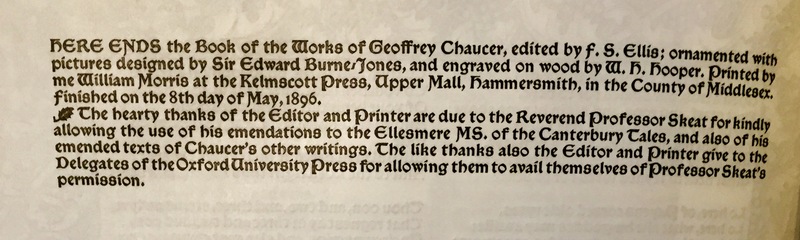
This particular copy is one of the volumes printed on vellum and is exceptionally heavy due to its large, folio format and thick boards. Houghton's vellum copy of the Kelmscott Chaucer was given Harvard University by Henry Authur Jones in 1906, and a letter accompanying this gift is tipped in at the front of the volume. The short title of the book (The Works of Geoffrey Chaucer) appears on folio A3v, and a list of the tales and their respective page numbers appears on A3r. The rest of the book is paginated at the bottom, outer margin. The full title page is intricately decorated with woodcuts designed by William Morris. The book's colophon appears on page 554 and is separated from the Kelmscott printer's devise on page 553. Printed at the Kelmscott Press in Hammersmith, England, this volume uses two-toned printing in black and red.
Binding