Comparands
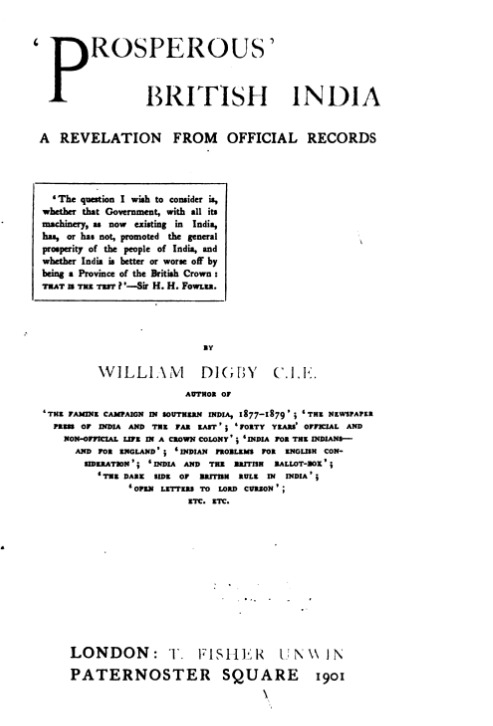
I have decided to include four works as comparands. The first book I thought to include is William Digby’s ‘Prosperous’ British India. I found this book in joint reviews with Poverty and Un-British Rule, and was aware from Naoroji’s correspondence that Digby was a friend and ally. The overall approach of the book is very similar to that of Poverty and Un-British Rule, in that Digby uses official statistics to argue that India is poor, and lays the blame on the “drain of wealth” engendered by British rule. Where it differs is that it has a more logical structure, beginning with a discussion of India’s poverty and then going to explain famines in that light, and then attributing both phenomena to the Drain, and then addressing specific critics.
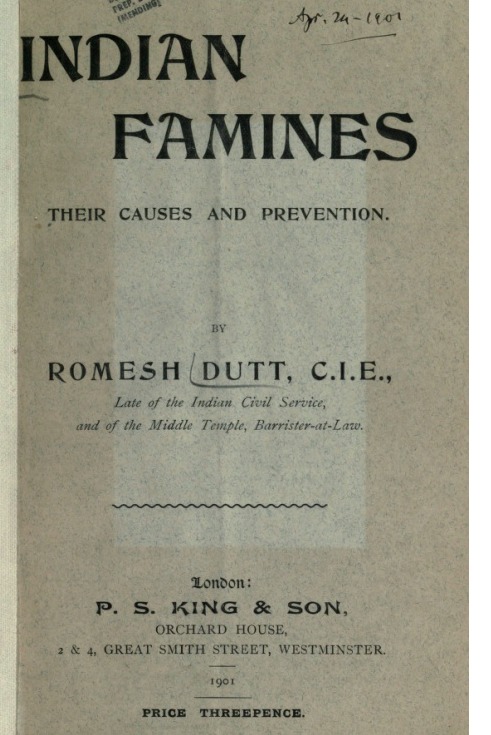
I also included a pamphlet by R.C. Dutt on Indian famines. Dutt was a former Indian Civil Servant, leader in the Indian National Congress and academic, who in 1901 was teaching at the University of London. I included this pamphlet for two reasons. Firstly it speaks to the particular prominence of famines within debate in Britain about India: while the content is in many ways a punchier version of Naoroji and Digby’s works, the concision forced upon it by the pamphlet medium leads Dutt to focus on the especially conspicuous issue of famine. Secondly, I had come across correspondence between Naoroji and Dutt in which Naoroji argues that Dutt is wrong to attribute equal responsibility for India’s poverty to taxation as to the Drain. Furthermore, at this time Indian nationalists in India were moving towards advocacy of protectionism in India rather than simply hoping for less burdensome imperial rule. I find Dutt’s pamphlet interesting in that he advocates both for palliative measures—lighter taxation and irrigation works—and for a lessening of the Drain. Naoroji’s criticism is apt here, in that the effect is to detract from the reader’s impression of the importance of the Drain, although it does make for a more realistic attempt to address the problem of famine. Dutt’s rhetorical style, which leans heavily on quoting British officials, is very similar to Naoroji’s. Thus looking at Dutt’s presentation places Naoroji’s in context, illustrating how Indian nationalists—presumably wary of accusations of sedition, after all, Dutt given his experience in India could have spoken on his own authority—attempted to frame their perspectives as entirely objective and in line with official opinion, even while criticising it.
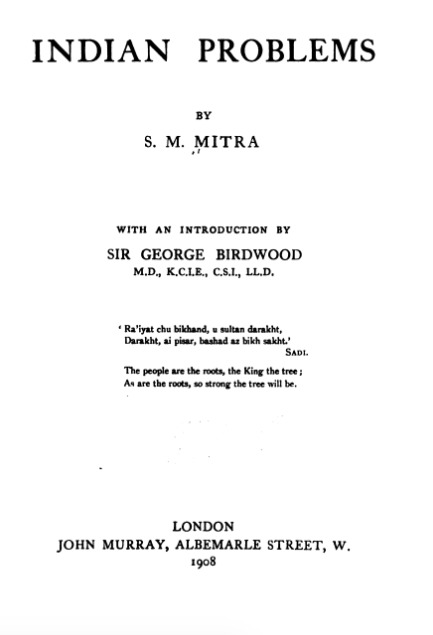
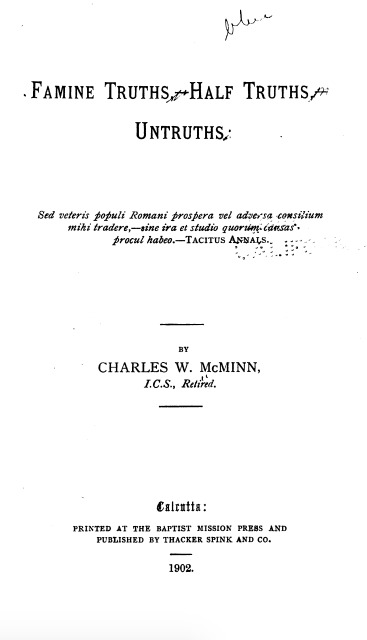
I have also included two books critical of Dutt and Digby. S.M. Mitra was an Indian journalist resident in London. His Indian Problems is a collection of essays on a number of themes. While Mitra explicitly criticised Dutt and the Indian National Congress, and was generally supportive of British rule, he nonetheless also criticised certain aspects of British policy towards India, such as India’s exclusion from schemes of imperial preference. Indian Problems is interesting in that it shows how the issue of Indian policy was debated across various binaries: pro- and anti-nationalist, Liberal and Conservative, protectionist and free trade. Along these lines the book carries an introduction by George Birdwood, a civil servant in the India Office who Naoroji was in correspondence with. Lastly Famine Truths, Half Truths, Untruths is a direct attack on Digby and Dutt: the preface references both. The author, Charles McMinn is identified on the title page as a retired Indian Civil Servant. McMinn takes a historical view of the problem of Indian famines, arguing that they were a feature of Indian history, before going on to criticise specific aspects of Dutt and Digby’s works. This work differs from the others in that it was published in India, in Calcutta. This phenomenon perhaps speaks to the incidence of censorship, which would have been more excessive in India, and so Indian nationalists like Dutt and Naoroji only officially distributed their works in Britain. Additionally, McMinn makes no reference to Naoroji, suggesting that in 1902 Dutt and Digby’s ideas were far more widely disseminated, and debated than Naoroji’s, which had been expressed in similar forms since the 1870s.