Report on Authorship
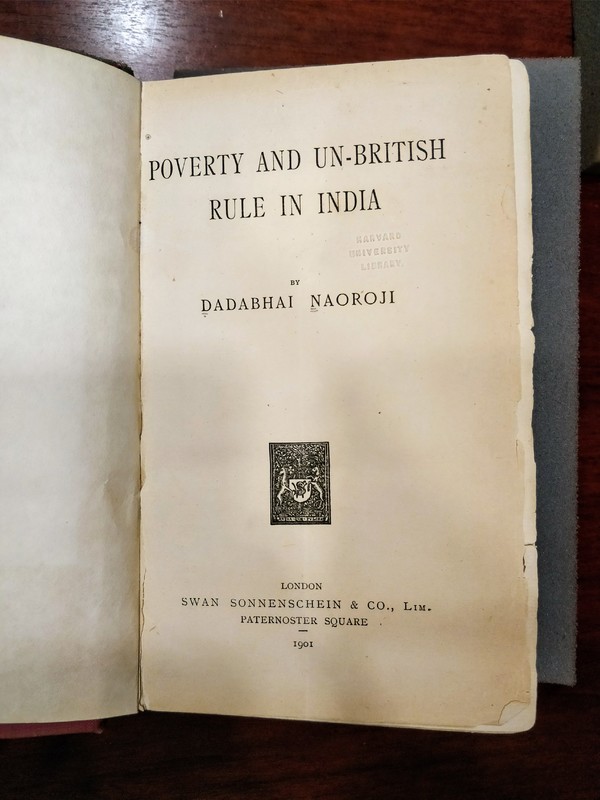

There are two key elements to the authorship of Poverty and Un-British Rule in India. Firstly, the book was largely a collation of already-published works, and included reprints of various correspondences between Naoroji and British government officials. Secondly, it was not particularly cheap, suggesting that the printing was more a commercial than a political venture. The book contains very little information about Naoroji. While a reader would surmise from his speeches in parliament that he had been an MP, there is no direct mention of this, nor any biographical details (for a more detailed explanation of who Naoroji was, see the material bibliography). This may have been a deliberate feature, drawing attention away from the author and his perspective, and more to his ideas, and the people he quoted. The introduction opens not with an exposition of Naoroji’s opinions, but with block-quotes of pledges by British governments to govern India equitably.
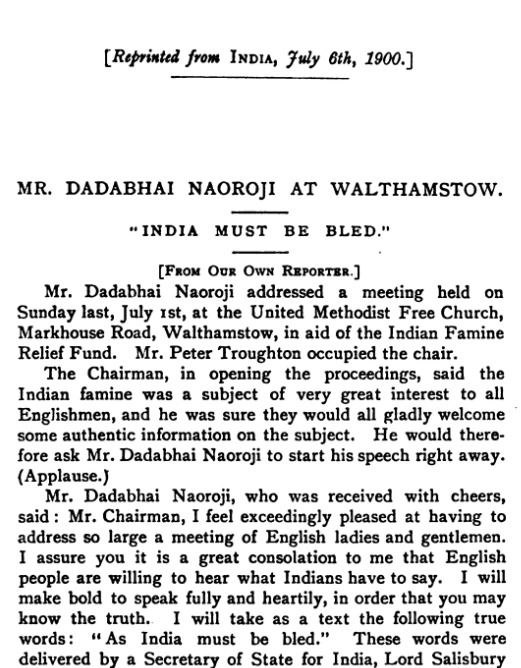
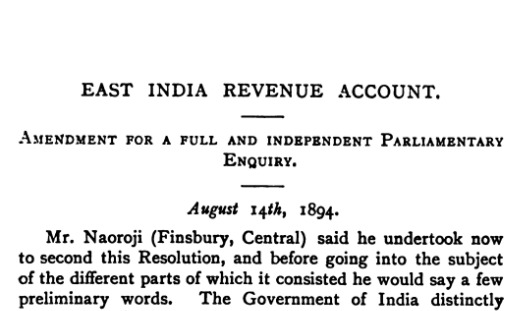
The attached table summarises the provenance of the different components of Poverty and Un-British Rule (access it here: https://docs.google.com/spreadsheets/d/1u6zPCL8jI-Dx52F8Ct6DMZhm-MyM7-Bk8ya-z22qOo0/edit?usp=sharing). Interestingly, almost all of the book had already been published in a standalone book, pamphlet or newspaper article, in Britain. Yet this is frequently not credited in the book. It seems that the origin of a text is cited where it lends it authority, and that this does not always coincide with acknowledging earlier publication. For example, in Naoroji’s speeches in parliament, the fact that the speech was given in parliament is mentioned, but the fact that the speech had already been published as a pamphlet is not mentioned. In cases where the original publication is mentioned, for example in Naoroji’s speeches at public meetings in Britain, which cite articles in India, the journal of the British committee of the Indian National Congress, it seems to be linked to fair attribution. More interestingly are the cases—especially prominent in the reprints of Naoroji’s correspondence on certain matters—in which the writings of Naoroji’s interlocutors are included. It is unclear whether they consented to this, though it seems unlikely: Naoroji published his correspondence with the Army and Admiralty to expose anti-Indian prejudice in recruiting practises for officers. While it is unlikely that the authorities were embarrassed by this, that Naoroji thought it was worthwhile to print these correspondences suggests that he thought it would promote his attempts to persuade the British to run India on more equitable and democratic lines.
The question of why this book was published, given that it contains little new material—which could have been more easily disseminated in a pamphlet—is therefore interesting. It is tempting to view this as an attempt to publicise Naoroji’s views, and perhaps reach an audience (in Britain) that had not had access to the original publications in various London-based pamphlets and journals, or to reinject certain views into the British political debate. For example, the first essay, “Poverty of India,” in which Naoroji explains his theory that British rule had impoverished India by draining wealth by remitting excessive taxes to Britain, had been published in Britain in book form in 1876, 1878 and 1888. Reissuing it in 1901, accompanied by additional information ensured that it remained part of political debate. Furthermore, the details of Naoroji’s speeches and recent political actions provided more succinct and attention-grabbing formulations of this overall thesis: in a speech at Walthamstow Naoroji quoted the Conservative leader Lord Salisbury’s expression that “India must be bled” to exemplify the attitude of those in British politics, especially in the Conservative Party who opposed measures to make the administration of the empire more equitable. These actions were important, given that Naoroji, despite having lost his seat in parliament as a Liberal in 1895, was still very much involved in British politics, and indeed contested a seat in the 1906 election.
Yet while it seems likely that Naoroji consented to have this book published as a way to disseminate his ideas, it would appear the publisher had much more commercial intentions. One might expect that the book was cheap—the ragged condition of the book in Harvard’s collection would suggest so—but that was not the case. While the paratext contains no clues about the price, a review in The Spectator mentioned that the price was 10s. 6d., a price that was not excessive—a book about scarab beetles reviewed on the same page had the same price—but not cheap either: it was almost three times as much as a dictionary of Egyptian archeology also reviewed there (see https://search-proquest-com.ezp-prod1.hul.harvard.edu/docview/1295460042/fulltext/C91E0D0DA64B4E99PQ/14?accountid=11311). Furthermore most of the book had already been printed, which presumably made the typesetting easier and thus cheaper (though the book was reset, or at least the typesetting of the section “Poverty of India” differs from that of the 1888 edition). Thus it seems that commercial pressures played a decisive role in the publication of Poverty and Un-British Rule, repackaging already-printed essays, avoiding attribution wherever possible and thus implying an unreasonable degree of novelty.