Reception History
Reviews of Poverty and Un-British Rule in British periodicals split between those that accepted Naoroji’s conclusions in their entirety, and those that rejected them in their entirety. The Saturday Review took issue with Naoroji’s treatment of statistics, arguing that he had used “deceptive methods” to reach “false conclusions.” (“The Poor Indian’s Untutored Mind,” The Saturday Review 93, no. 2411 (January 11, 1902), 50). Some reviewers, such as that of the London Quarterly Review, criticised the book’s format, as “the utter absence of arrangement will largely defeat the author’s object.” (“Poverty and Un-British Rule in India,” review, London Quarterly Review 8, no. 1 (July 1902), 205) Similarly, The Spectator found the compilation confusing, noting that Naoroji “will not win many adherents to his theory that India is over-taxed by making public such eccentricities as the correspondence with the Admiralty (17 pp.), in which he demands that natives of India be given commissions in the Navy.” (“Mr. Naoroji’s ‘Poverty in India,’” The Spectator, January 25, 1902, 116.) Yet for those reviewers who accepted Naoroji’s diagnosis, the book was “an important work on an important subject.”(“Sociology, Politics and Jurisprudence,” The Westminster Review 156, no. (November 1901): 584–585.) While the Saturday Review sneered that “There is however one advantage in the resurrection of these venerable jeremiads. Time has demonstrated their falsehood,” (“The Poor Indian’s Untutored Mind,” 50) the Westminster Review reached the complete opposite conclusion, noting that “Mr. Naoroji’s figures then published are now proved to be accurate.” (“Sociology, Politics and Jurisprudence,” 585.) This mixed response suggests that while many of the documents published by Naoroji in Poverty and Un-British Rule had been published before, there was no substantial consensus about the effects of British rule on India.
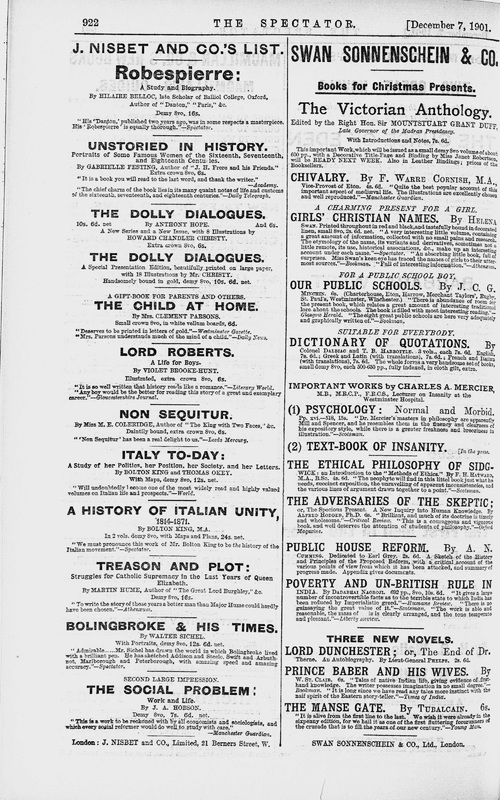
Examining advertisements for Poverty and Un-British Rule provides further clues as to how it was received in Britain. An advertisement in the Liberal periodical The Speaker quoted newspaper reviews to argue both that the book included “a large number of incontrovertible facts as to the terrible state to which India has been reduced by Imperialistic greed” (Humane Review, quoted in Advertisements, The Speaker, January 4, 1902, 403), but that it would not threaten the reader’s national pride: “Mr. Naoroji is an unfaltering friend of England. The England that he admires is the country whose sentiments were clothed in noble language in the Proclamation of 1858 … the England that he criticises is the country that has insisted on ruling India as a conqueror instead of a trustee.” (Daily News) Thus criticism of British rule was separated from criticism of Britain. In line with its commercial aims, this advert promised that “The work is able and reasonable, the mass of facts is clearly arranged, and the tone temperate and pleasant.” (Liberty Review) It may seem odd that the publishers saw fit to advertise the “temperate and pleasant” tone of a book about famine and fiscal policy, but it speaks to how the book was aimed at the general reader. An advert in The Spectator listed Naoroji’s work among other “Books for Christmas Presents,” a list that included other deep and challenging titles such as “Girl’s Christian Names” (“A charming present for a girl”) and “Our Public Schools” (For a public school boy”). (Advertisements, The Spectator, December 7, 1901, 922.) Admittedly, there was more scholarly fare available other works advertised included “important works” by one “Lecturer on Insanity at the Westminster Hospital” and a text on “The Ethical Philosophy of Sidgwick.” It seems Naoroji’s text was pitched to appeal to the socially conscious reader, who needed to be kept informed about political and scientific issues. Yet it would also appear that the book was pitched a little like Piketty’s Capital, an interminably long and unreadable book that appealed to readers—or at least to shoppers—precisely for that reason.
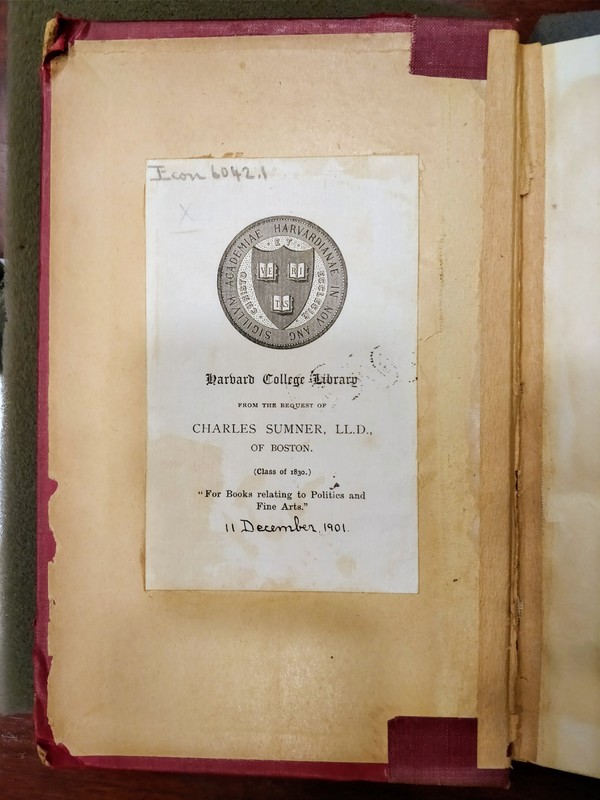
The book was disseminated internationally. Harvard’s libraries acquired a copy on December 11, 1901 using a bequest “For Books relating to Politics and Fine Arts.” (See image) They were not the only ones. According to the Bulletin of the American Geographical Society of New York, that organisation acquired a copy “by purchase” in 1902. (“Accessions to the Library, May-June, 1902,” Bulletin of the American Geographical Society of New York 34, no. 1 (1902): 266.) Furthermore, the copy in Harvard’s collection was apparently well-used, as can be inferred from the state of the binding.
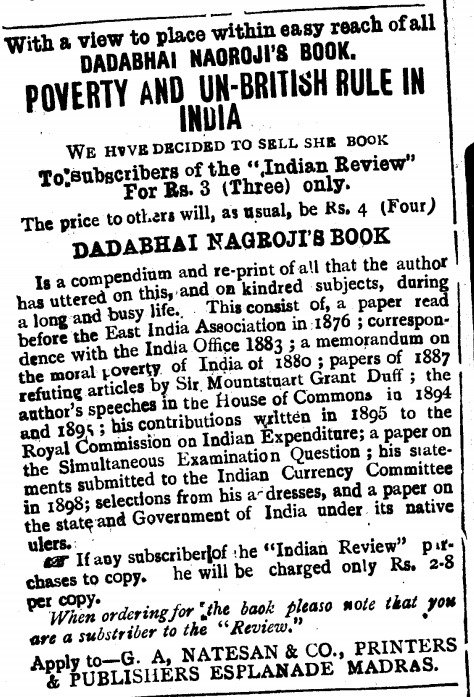
The more interesting story, however, concerns the reception and dissemination of the book in India. From adverts in the Pioneer, a newspaper written for and by British officials in India, we can see that the Bombay and Madras based bookseller A.J. Combridge & Co. was selling copies—presumably from Britain—for 7 Rupees and 14 Annas. (Advertisements, The Pioneer, January 1, 1902, 14.) However, the Indian publisher G.A. Natesan, in the Indian Amrita Bazar Patrika, and in the South African Indian Opinion in 1905 advertised the book amongst “Books You Should Read,” interestingly framing Naoroji’s book not as an interesting diversion or potential Christmas present, but as essential information for politically-engaged Indians around the British empire. (Advertisements, Indian Opinion, March 11, 1905, 24.) The haphazard compilation criticised in Britain was part of the selling point, as the book contained “all that the author has uttered on this, and on kindred subjects, during his long and busy life.” Furthermore, copies sourced by Natesan were considerably cheaper: while in Britain the book sold for 10s. 6d., in South Africa it could be had for 6 shillings. While the copy sold to British readers in India fetched 7 Rupees and 14 Annas, Natesan sold copies for 4 Rupees, or 3 for subscribers to the “Indian Review,” a sale specifically implemented “With a view to place within easy reach of all” Naoroji’s tome. (Advertisements, Amrita Bazar Patrika, August 31, 1905, 1.) Thus we see politically oriented Indian publishers—Natesan was active in the nationalist movement—attempting to disseminate Naoroji’s work for explicitly political goals. An alternative reading might however be that Natesan was simply using unsold copies to shift subscriptions: he edited the Indian Review.
While the pre-publication history of Poverty and Un-British Rule is rich (see page on authorship), the book’s printing history is much more scarce. The book was translated into Hindi and published in Delhi in 1928, eleven years after Naoroji’s death, and subsequently published in India in English in 1962. Surprisingly, there is no mention in WorldCat, the British Library’s catalogue or the National Library of India’s catalogue of an edition published by Natesan in the 1900s. While it may be the case that Natesan simply bought copies from the London publisher Sonnenschein & Co., that seems unlikely, as to do so, and then sell at a loss, would be commercially disastrous. Rather, it seems that Natesan was producing a pirate copy which was never formally registered or acquired by an official library. Curiously it seems impossible to find any copies of such a book anywhere, which may suggest that the book was exceptionally poorly bound, which would be in keeping with its very low price.