Authorship
Yamamoto Sanehiko, the former president of Tokyo Mainishi Shinbun (東京毎日新聞, literally “Tokyo Daily News”), is the founder of Kaizousha, which was indeed established mainly to support the publishing of Kaizo from the very beginning. With exactly the same name, they were closely tied with each other and funded solely with his personal property. But nowhere in the magazine explicitly claims that it is published under the name of Yamamoto. On the back cover, it is stated that Kaizo is “a monthly review of politics, literature, social affairs, etc.” and published by Kaizousha. For journalist Yamamoto, whose profession and pursuit had little to do with advocating particular ideologies, the magazine was to follow the example of the general-interest magazine like Chuokoron (中央公論, The Central Review) and intended to pave the way to realize his aspiration in politics by gaining a wide readership and reputation for the political election.
The magazine and the publishing house are generally taken as the personal cause of Yamamoto, he actually gave full authority to the two editors’ work during the start-up stage in 1919 when Kaizo struggled to become competitive in the market and against its financial crisis. The very first few issues on labor issues and leftist thoughts that gained Kaizo its first popularity were picked up by the two editors. With no enough knowledge in the field, however, they were indeed under the guidance of several different contributors who were known for their works and activities regarding socialism. Yamamoto barely showed up during the editing process at the time. But it is for sure that the publication would have been impossible without his acquiescence and funding. Notably, given the increasingly strict state censorship, the editor would bring a preview to the Home Ministry Police Affairs Bureau to get publication approval and thus had to revise the content under the official’s “advice”. Thus the early published issues as we see now did not conform to the intentions of Yamamoto or any of the editor and contributor. As Kaizo had gained substantial influence since late 1920s, however, Yamamoto again took overall control and directed its publication largely in line with his initial goal of cultural enlightenment.
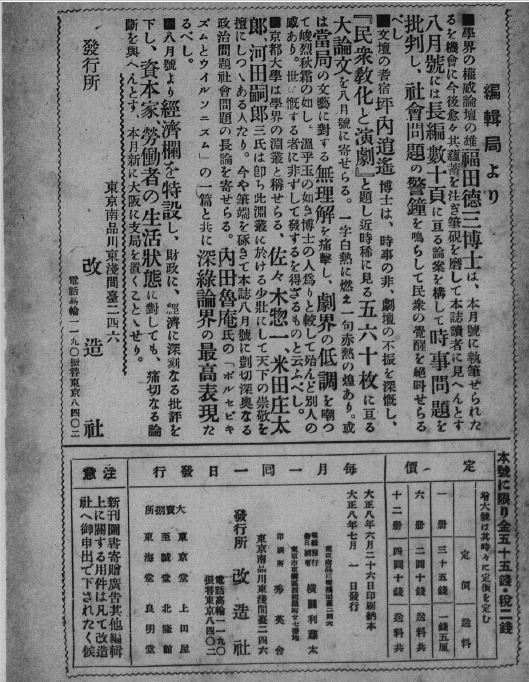
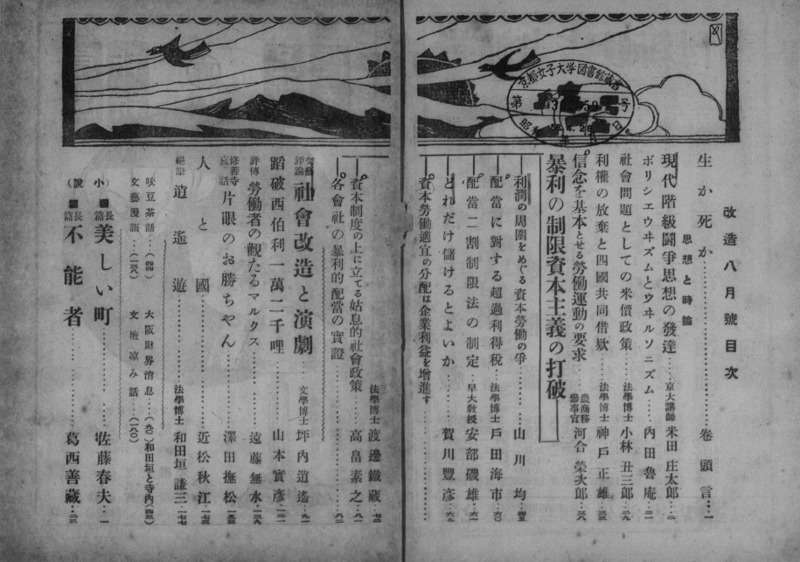
The magazine consciously enhanced its competitiveness in commerce and reputation. Notably, Words from Editors kept reporting on such efforts made on the part of the publisher and constantly expressed its resolution to “side with contributors and readers”. This part is a significant clue to trace the publishing issues as well as an editing strategy to appeal to its audience. Despite the financial difficulties, it continued to offer a payment to its contributors higher than average and that of the most influential Chuokoron. It launched several campaigns to cut the price and encourage readers’ subscription for six months or one year at a lower price and direct delivery, as noted in the colophon. Words from Editors would also notice the contents of the following issue, with keywords regarding particular article, fictions and the authors printed in larger boldface. The table of contents prints the authors of articles together with their affiliations when they are professors of influential universities or officials. I believe these all indicate the magazine’s appealing to readers from the middle-lower class while also trying to configure their reading habits.