Comparands
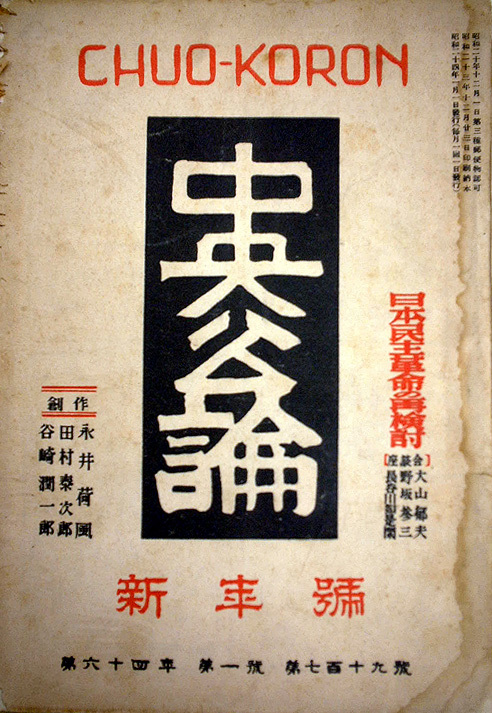
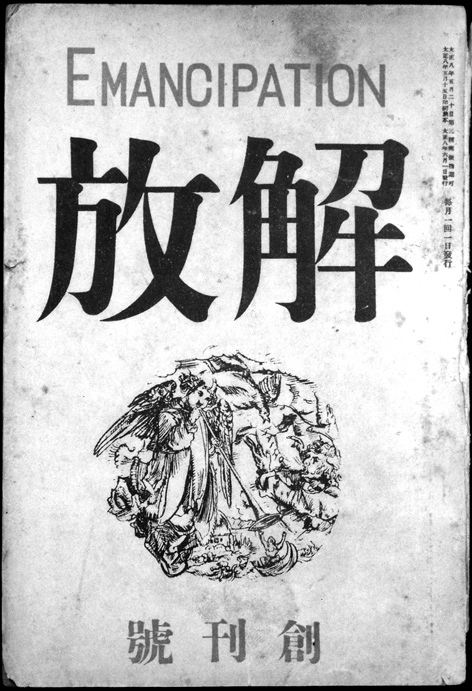
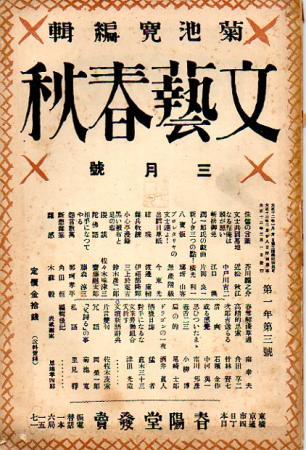
These three comparands are magazines published in the early twentieth century in Japan (Central Review is relatively earlier in the late nineteenth century). They are all catagorized as sōgō-zasshi (総合雑誌, literally general magazine).[1] Examining them together with Kaizō sheds light on the common practice of publishing such type of magazines in modern Japan and helps to discern the competitiveness of Kaizō as well as the challenges it faced.
Chūōkōron (中央公論, Central Review)
The magazine was first published in January 1887 under the title Hanseikai Zasshi (反省会雑誌) in Kyoto by the Hanseikai (反省会 Review society), a literary group of professors and students of Ryukoku University. It soon became one of Japan's foremost general-interest magazines. In general, Chūōkōron served as a public forum for liberal-leaning debates, echoing to its earlier influence in promoting the political of establishing the party cabinet and democratic government. But when socialism and the left burgeoned in Japan after the Russian Revolution along with growing social inequality and labor dispute at home, few periodicals were influential enough to serve as such space for intensive discussion of new social problems and ideas. It was exactly under such circumstance that Kaizō found its niche.[2]
As mentioned in previous sections, when preparing for the publication of Kaizō, Yamamoto took the advice of his former colleague in Tokyo Mainichi Shinbun (東京毎日新聞, literally “Tokyo Daily News”) and decided to follow the path of Chūōkōron. The first three issues were qualified imitations of its predecessor, arranged in three columns and composed of ample contents contributed by influential intellectuals. Indeed, Chūōkōron also published several articles by the noted scholar Yoshino Sakuzo with similar topics on “Kaizō (Reconstruction)” in its recent issues. In such case, however, readers barely had reasons to choose the new comer, not to mention its price was 60 sen in contrast to the 40-sen Chūōkōron.[3] Thus it is plausible to argue that the following issue was indeed a turning point, with an explicit topic on “socialism and labor problems” and a lowered price of 35 sen. Starting from this issue, Kaizō enhanced its competitiveness against Chūōkōron mainly in these two aspects as a left-leaning public forum with a more affordable price.
Kaihō (解放, Emancipation)
This magazine was published in 1919 as a mouthpiece publication of Reimeikai (黎明会, lit., “Society for Enlightenment”), whose founders included the noted scholars Yoshino Sakuzo and Fukuda Tokuzo. The group came together "to propagate ideas of democracy among the people." Its membership supported universal suffrage and freedom of assembly. Most editors were actually from a sister group of progressive students called Shinjinkai (新人会, lit., “Society for New Human”). Along with the development of these groups, Kaihō took a stance of radical liberalism and then shifted to socialism. In the first five years, the staffs of Kaizō consciously took this peer magazine as the major rival. Indeed, they would not have pinned down the editorial idea of Kaizō so well without being attentive to its peers.
However, the publishing house was burnt down in the 1923 Great Earthquake. New staff took on the publication afterward and converted to a more radical leftist stance. It became the base for an active group of proletarian literature authors yet lost its competitiveness as a sōgō-zasshi. The magazine ceased its publication in this form in 1927 due to the sales slump. The short-lived Kaihō is a good contrast in demonstrating how taking a relatively neutral stance and marketing strategies contributed to the continuing publication success of Kaizō.
Bungeishunjū (文藝春秋)[4]
Bungeishunjū covers a wide range of topics from politics to sports. Each issue usually contains about 30 articles by politicians, researchers, journalists or non-fiction writers. Presented itself firstly as a literary magazine, it was relatively less competitive and influential as Chūōkōron, Kaihō and Kaizō. Starting from the late 1920s, Bungeishunjū was transformed to a sōgō-zasshi, gaining popularity and reputation rapidly with its establishment of the Akutagawa Prize. There is no explicit interaction between Kaizō and Bungeishunjū, which was furthest from the former in the political spectrum. Throughout its history, the magazine has constantly taken a conservative stance, with strong support for the emperor and criticisms toward the leftists. It claimed itself as never featuring articles by members of the Japanese Communist Party or the Social Democratic Party (but there are some exceptions).
Comparing with the publishing history of the other magazines, however, the late rising of Bungeishunjū indicates a shift of gravity in Japanese society away from active discussions of socialism. Kaizō ceased publication finally in 1955, whereas Chūōkōron and Bungeishunjū last till now. Furthermore, according to the survey of national reading trend by the Mainichi Newspaper in 1947-1984, the rank of the former fell out from top 10 to the 39th in 1984. By contrast, Bungeishunjū has maintained its ranking of top 3 since 1950.
[1] A common practice, sōgō-zasshi has not got its name yet by 1919 when Kaizo was published (the term firstly used in the 1930s). According to the definition in Kōjien Japanese dictionary, it generally referred to a particular type of magazine whose content consists of various types of articles and literature composition in diverse fields such as politics, economy, philosophy, science, etc. During the early twentieth century, the contents were generally arranged in three columns.
[2] There were a few independent magazines published by scholars to introduce their own ideas on socialism, not in the form as sōgō-zasshi.
[3] As a general sense of the value of one sen, rice price then was 50 to 60 sen per sho (1.8 liter).
[4] There is no official translation of its name. It is a combination of two words, bunkei文藝 and shunjū 春秋. Bunkei simply means art and literature. Shunjū is an expression of passing time, and sometime implies a way of writing history critically with one’s own value judgment.